
Schön, dass Sie sich für den GoITSystems Newsletter registriert haben.
Sie erhalten in Kürze eine Bestätigungs-E-Mail. Bitte bestätigen Sie Ihre Anmeldung über den darin enthaltenen Link, um den Anmeldeprozess vollständig abzuschließen.
Falls Sie keine E-Mail erhalten, prüfen Sie bitte auch Ihren Spam-Ordner.
Digital transformation in German public administration fails less due to a lack of technology than because administrative processes are insufficiently understood, documented, and managed. Process intelligence—understood as the public sector’s ability to systematically capture its processes, analyze them in a data-driven way, steer them in a targeted manner, and continuously improve them—forms the operational foundation of effective digitalization and responsible AI use.
Conceptually, process intelligence builds on established Business Process Management (BPM) but extends it through data-driven analysis and AI-enabled decision mechanisms Dumas et al., 2018. From a design science perspective, process intelligence can be understood as a socio-technical artifact that integrates organizational structures, methods (e.g., BPMN, DMN, process mining), and technical systems in order to address the problem of fragmented digitalization in public administration Hevner et al., 2004.
Digitalization initiatives in the public sector often focus on the technical implementation of existing procedures. In practice, this means that analog inefficiencies—such as redundant checks, media discontinuities, or unclear responsibilities—are transferred unchanged into digital systems. The result is digitized legacy processes instead of structural improvements, as documented in the e-government literature on fragmented modernization approaches Janssen & Cresswell, 2006.
Effective digitalization therefore requires prior analysis and redesign of the underlying processes, as formalized in the BPM lifecycle phases of process analysis and process redesign Dumas et al., 2018.
AI systems strongly depend on clearly defined processes and consistent data structures. Studies on algorithmic decision support in public administration show that unclear decision rules and heterogeneous data sets lead to bias, opacity, and limited scalability Veale & Brass, 2019. In environments characterized by high process variance, unclear decision rules, and low data quality, AI solutions reinforce existing inefficiencies instead of compensating for them.
Process intelligence describes an organization’s ability to understand, manage, and adaptively further develop its business processes on a data-driven basis. It thus stands in the tradition of BPM, which the IS and management literature describes as a holistic approach to identifying, modeling, analyzing, improving, and automating processes Dumas et al., 2018. At the same time, process intelligence addresses the “missing link” problem between information systems and actual process execution that is emphasized in the process mining discourse van der Aalst, 2016.
In the sense of Design Science Research, process intelligence can be conceptualized as an integrated artifact that brings together methods (BPMN, DMN, process mining), organizational roles (process owners, governance bodies), and technical infrastructure (process-capable line-of-business systems, event logs) in order to address a clearly defined relevance problem—the stagnation of digitalization in public administration Hevner et al., 2004.
From a DSR perspective, process intelligence consists of an ensemble of artifact building blocks—conceptual models, methods, and technical components—that jointly enable a process-intelligent public administration Hevner et al., 2004.
Process screening is the starting point and serves to systematically capture, prioritize, and assess administrative processes. It operationalizes the process identification and documentation phases in the BPM lifecycle and creates a sound basis for subsequent design and evaluation steps Dumas et al., 2018.
BPMN 2.0 enables standardized and cross-organizationally comprehensible process modeling and is established in the IS literature as the de facto standard for process modeling Dumas et al., 2018. For public administration, BPMN creates the precondition for integrating business and technical perspectives on administrative workflows and for supporting model-based automation approaches.
The Federal Information Management (FIM) framework complements BPMN with public sector–specific structuring of services, data, and processes. It operationalizes the idea of standardization, which the digital government literature highlights as a prerequisite for cross-organizational re-use and scaling Scholta et al., 2019.
Decision Model and Notation (DMN) enables explicit, formally structured representation of decision rules. From an AI governance perspective, DMN provides a transparent foundation for rule-based and AI-supported decisions and is crucial for the traceability and auditability of algorithmically supported administrative decisions Veale & Brass, 2019.
Process mining closes the gap between modeled to-be processes and real as-is executions by using event data (event logs) to reconstruct actual process variants, bottlenecks, and compliance deviations van der Aalst, 2016. For public administration, process mining provides the empirical basis on which process intelligence can evolve from a purely model-driven approach into a data-driven capability for process steering.
From the perspective of the DSR relevance criterion, process intelligence addresses a clearly defined practical problem: AI pilot projects in public administration often remain isolated, non-scalable, and difficult to explain. The literature on algorithmic decision-making in the public sector points in particular to poor data quality, unclear decision logic, and weak governance structures as key causes Veale & Brass, 2019.
The outlined maturity model (from “ad hoc” to “AI-ready”) can be understood as a conceptual artifact in the sense of Hevner et al., 2004. It structures the development paths of public organizations and makes it possible to plan and evaluate design decisions along defined maturity levels (documentation, standardization, data-drivenness, AI integration).
Empirical studies on BPM show that structured process design and management lead to measurable gains in efficiency and quality, for example in the form of shorter throughput times, lower error rates, and improved service quality Dumas et al., 2018. In a DSR setting, these metrics can serve as evaluation criteria for process intelligence artifacts.
Explicit process and decision models increase traceability, auditability, and legal certainty—a core requirement in the public sector. In the debate on “algorithmic accountability,” it is emphasized that transparent decision rules and documented workflows are prerequisites for legitimate AI-supported decisions Veale & Brass, 2019.
Standardized models following FIM and BPMN logic support the “one-for-all” principle, which the German-speaking e-government discourse views as key to scaling digital public services Scholta et al., 2019. From a DSR perspective, this represents an important criterion for the broad impact of the artifact.
Documented and standardized processes facilitate the implementation of regulatory changes and organizational adjustments. The public administration and public management literature discusses this as a central dimension of administrative resilience and change capability Bouckaert & Halligan, 2008.
Process intelligence can be understood as a comprehensive socio-technical artifact in the sense of Hevner et al., 2004. It combines conceptual models (maturity model, levels of process intelligence), methods (screening, BPMN, DMN, process mining), and technical implementations (event-based system logs, workflow systems) and thus addresses a key relevance problem of administrative digitalization.
For a DSR paper, formative evaluations along the maturity levels and summative evaluations using metrics for efficiency, quality, transparency, and scalability are particularly suitable Hevner et al., 2004. In addition, applying the Hevner guidelines to process intelligence artifacts themselves can become the subject of a conceptual or empirical study Gregor & Hevner, 2013.
Process intelligence is a central precondition for successful digitalization of public administration and scalable AI deployment. In the IS discourse, it links BPM, process mining, and AI governance into an integrated, design-oriented approach that addresses the relevance problem of fragmented and technology-driven digitalization initiatives Dumas et al., 2018van der Aalst, 2016. As an artifact in the sense of design science, process intelligence offers a structured framework for integrating and systematically evaluating process, data, and AI perspectives in public administration Hevner et al., 2004.
I am a scholar of digital transformation who examines how digital technologies reshape organizational strategies, processes, and enterprise IT architectures – and how these transformations can be designed to generate measurable impact. After earning my doctorate in Information Systems at the Technical University of Munich under Prof. Dr. Helmut Krcmar, I have spent many years conceiving, leading, and implementing digital transformation initiatives at the intersection of academia, public administration, and industry.
Grounded in the Information Systems tradition of Prof. Dr. Helmut Krcmar and process-oriented modeling in the lineage of Prof. Dr. August-Wilhelm Scheer, my work focuses on connecting rigorous research with the design of real-world, complex process and systems landscapes. I bring together theoretical concepts, empirical evidence, and implementation experience to develop an integrated perspective on digital transformation in government and higher education.
Digital Transformation Project Lead (Public Sector)
Technical University of Munich – SVP & CIO / IT Service Center
Senior Researcher and Project Lead
2019–2022
Chair for Information Systems, TUM (Prof. Dr. Helmut Krcmar)
Research Associate
2013–2019
Department of Informatics, Technical University of Munich
Program Coordinator B.Sc. Information Systems
2013–2018
Technical University of Munich
Student and Research Assistant
2008–2013
UnternehmerTUM, Garching by Munich
Project Lead “Smart Meter”
2006–2007
BAGHR e. V., Eichstätt<
Digital transformation, efficiency and effectiveness, feedback systems, and digital services – particularly in public sector organizations and higher education.
At the core of my research are questions of how strategies, processes, and IT architectures can be aligned so that digital solutions not only function technically, but also generate sustained organizational impact.
In Information Systems, there is a broad spectrum of methods that are used to analyze, design and optimize information systems and business processes. These methods are essential for the effective design of the interface between business and information technology.
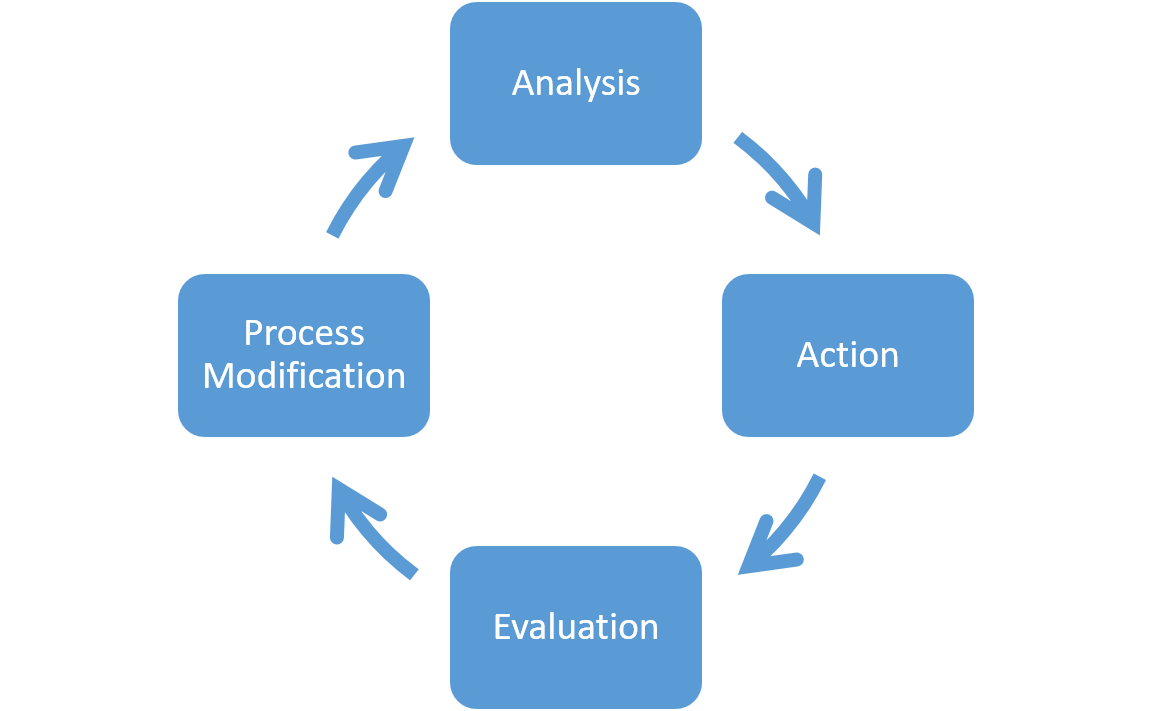
In short, action research is about solving a real-world problem. The problem can be practically or theoretically oriented. Action Research consists of three steps: analysis, action, and evaluation [1]. For clarification purposes, I separate the step of evaluation into evaluation and process modification. Figure 1 demonstrates the approach of action research, which consists of a cycle.

The goal of action research is to facilitate change and improvement in an organization, community, or other social context by actively participating in the design of solutions. Action research views concerns and challenges as shared issues and seeks participatory approaches to address them.
Thus, the goal of action research is to bring about positive change through the active participation of stakeholders in researching and solving difficulties. This involves creating knowledge and understanding of the contexts under study and developing and implementing practical solutions.
Action research is particularly useful in solving social problems that are influenced by complex internal and external factors. By involving all stakeholders in research and solution finding, a broader and deeper perspective can be gained, which can lead to a better solution.