Select your language


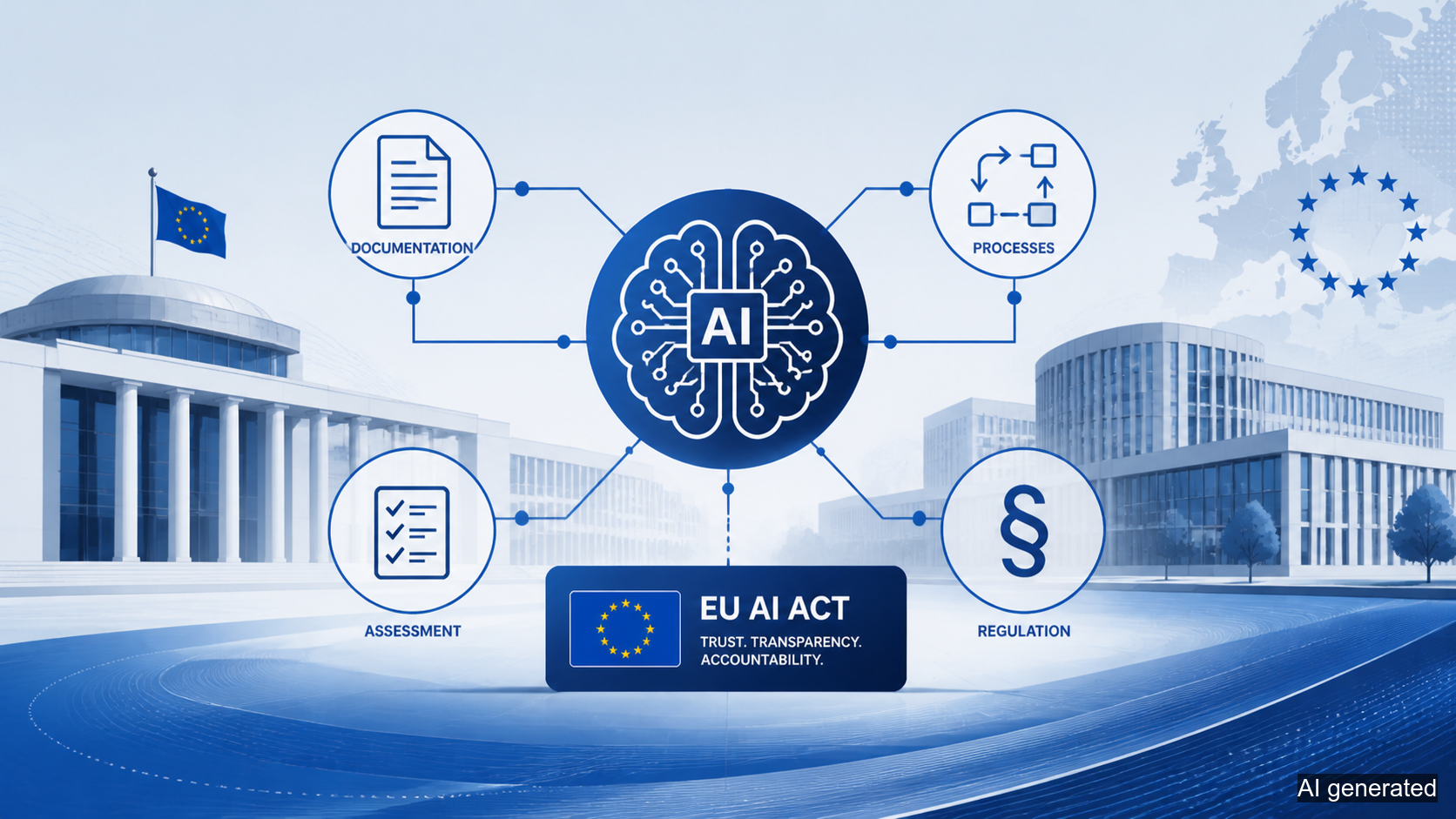
Context: AI Deployment as a Socio-Technical Governance Challenge
With the EU AI Act, the European Union has established, for the first time, a binding regulatory framework for the use of artificial intelligence (AI). This is of particular relevance for the public sector, as algorithmic systems are increasingly embedded in decision-making processes and thus directly affect administrative acts, resource allocation, and citizens’ rights.
From an information systems perspective, AI should not be understood as an isolated technology but as part of socio-technical systems in which data, algorithms, organizational processes, and human actors closely interact. Accordingly, the EU AI Act addresses not merely technical properties but primarily governance structures across the entire system lifecycle.
Risk-Based Regulatory Approach of the EU AI Act
The EU AI Act follows a risk-based classification approach, regulating AI systems according to their potential level of harm:
- Unacceptable risk: Systems that violate fundamental rights (e.g., social scoring by public authorities) are prohibited.
- High risk: Systems with significant impact on life circumstances or fundamental rights (e.g., allocation of benefits, access to education or employment).
- Limited risk: Systems subject to transparency obligations, particularly in user interactions (e.g., chatbots).
- Minimal risk: Systems without specific regulatory requirements.
For public administration, the category of high-risk AI is particularly critical, as many use cases—such as decision support in social welfare or automated classification of applications—fall under Annex III of the EU AI Act.
High-Risk AI in Public Administration: Characteristics and Examples
An AI system is typically classified as high risk if it:
- influences access to public services or government resources,
- is used to evaluate or classify natural persons,
- operates in safety-critical or infrastructure-related contexts.
For example, a system used to prioritize housing benefit applications falls into this category, as does AI-based decision support in employment services. In contrast, purely information-providing systems are primarily subject to transparency requirements.
Governance Requirements for High-Risk AI
The EU AI Act defines a comprehensive set of requirements, which from an information systems perspective can be interpreted as an integrated governance framework:
- Risk management: Continuous identification and mitigation of risks across the lifecycle (design, development, operation).
- Data governance: Ensuring data quality, representativeness, and bias control as prerequisites for valid models.
- Technical documentation: Transparent description of model logic, training data, and system limitations.
- Logging and auditability: End-to-end traceability of system decisions as a basis for regulatory oversight.
- Transparency: Disclosure of AI use to users and clear differentiation from human decision-making.
- Human oversight: Integration of control and escalation mechanisms (human-in-the-loop / human-on-the-loop).
- Robustness and security: Protection against errors, adversarial attacks, and system manipulation.
Importantly, the EU AI Act does not impose a blanket ban on automated decision-making; however, particularly for high-risk systems, it requires effective human oversight and the ability to intervene.
Implications for Information Systems: Process and Decision Integration
The regulatory requirements cannot be fulfilled at the level of technology alone. Rather, they require integration into existing organizational and process structures. This highlights the central role of the information systems discipline:
- Business Process Management (BPM): Modeling and standardization of administrative processes as a foundation for transparency and control.
- Decision Model and Notation (DMN): Explicit representation of algorithmic decision logic to ensure traceability.
- Data governance: Establishment of responsibilities, quality standards, and data flows.
- IT governance: Embedding AI systems within compliance, risk, and control frameworks.
This makes clear that AI governance is not an isolated compliance issue but an integral component of digital administrative architectures.
Recommendations for Public Authorities
- System inventory: Identify and classify all AI systems in accordance with the EU AI Act.
- Establish an AI register: Structured documentation, particularly for high-risk systems.
- Process modeling: Comprehensive modeling of AI-relevant processes using BPMN.
- Explicit decision logic: Use of DMN to formalize rule-based decisions.
- Control architecture: Definition of human-in-the-loop structures and escalation paths.
- Integration with data protection: Alignment with existing data protection impact assessments (DPIAs).
Conclusion: AI Compliance as a Function of Organizational Maturity
The EU AI Act should be understood less as a technological constraint and more as a governance framework for responsible AI use. For public administration, this implies that compliance is primarily a function of organizational maturity—particularly in process management, data governance, and decision architecture.
Public authorities that systematically develop these capabilities not only achieve regulatory compliance but also lay the foundation for scalable, trustworthy, and efficient AI applications.
Related Articles

The Paradox of German Digitalization
Germany is the world's fourth-largest economy, has invested billions in digitalization programs, and enacted the Online Access Act (Onlinezugangsgesetz, OZG) — a clear statutory mandate with a binding deadline of end-2022. Yet the Bitkom DESI Index 2025 ranks Germany only 21st out of 27 EU member states in the digitalization of public administration — behind both France and Italy (Bitkom, 2025). The INSM Government Digitalization Meter 2026, produced by the Institute of the German Economy (IW), puts concrete numbers to the failure: of 7,509 legally mandated individual services, only 823 were available nationwide as of early 2026 — barely eleven percent (Röhl et al., 2026). Three years after the OZG deadline, not a single German state can point to an implementation rate above 50 percent.
This failure is not accidental. It has structural causes — and they can be named.
Theoretical Framework: Socio-Technical System Failure
The findings below can be read through a common analytical lens: public sector digitalization in Germany fails due to a socio-technical mismatch — a systematic decoupling of technology deployment, process maturity, governance structure, and organizational change (Bogumil & Gräfe, 2024). This mismatch manifests in six causal clusters that are not merely additive but causally interdependent: inadequate process foundations, federal fragmentation, systemic media discontinuities, governance gaps, procurement law constraints, and insufficient change management.
Cause 1: Technology Focus Without Process Foundation
The first instinct in any digitalization initiative is almost always the same: "Which software should we buy?" The question of process — what is actually being digitalized — comes too late, or not at all. Fraunhofer FOKUS, in its 2025 EfA evaluation study, identifies inadequate coordination and transfer mechanisms as the core structural barrier: processes were not defined clearly enough to be digitalized across administrative levels (Rother et al., 2025).
Bogumil and Gräfe (2024) demonstrate, using the OZG as a case study, that most digitalization projects remained limited to "translating existing analog workflows into an internet-compatible process" — rather than fundamentally redesigning them (Bogumil & Gräfe, 2024). The result: a poorly defined, inefficient process gets digitalized. What you end up with is a digitally rendered but still inefficient system — one that costs more to maintain than the paper original.
Cause 2: Federal Fragmentation Without Coordination
Germany has approximately 11,000 municipalities, 16 federal states, and numerous districts and special-purpose agencies. Each level maintains its own IT infrastructure, procurement procedures, and specialized administrative systems. The EfA principle (Einer für Alle — "One for All") was designed to address this through a division of labor: one state digitalizes a service; all others adopt it (BMI, 2023).
In practice, reuse has fallen far short of that promise. Bogumil and Gräfe find that no mandatory reuse obligation exists — with the result that OZG developments compete with municipal standalone solutions, and states cling to their own portals out of institutional self-interest (Bogumil & Gräfe, 2024). The Fraunhofer FOKUS study adds a procurement dimension: municipalities face substantial hurdles in adopting EfA services — ranging from financial uncertainty and interface incompatibilities to complex procurement law requirements (Rother et al., 2025). As early as 2023, the Federal Court of Audit criticized redundant parallel developments, noting that the Federal Ministry of the Interior had been unable to provide central IT solutions on time (Bundesrechnungshof, 2023).
Cause 3: The Media Discontinuity Problem
Many so-called "digital" public services are digital only at the point of entry. A citizen submits an online form — which then gets printed out and processed by hand, or sent as a PDF email that someone manually rekeys. Bogumil and Gräfe document this mechanism: many OZG services lack electronic interfaces to specialist back-end systems and e-file platforms. "The result is media discontinuity — for instance, when application data submitted as a PDF must be retyped manually" (Bogumil & Gräfe, 2024).
The Federal Court of Audit frames this structurally: many OZG projects do not constitute a finished product from the implementing agency's perspective, because the OZG neglects internal administrative digitalization (Bundesrechnungshof, 2023). States typically funded the introduction of e-file systems or digital application forms — but not the integration of specialist back-end systems via interfaces.
Cause 4: Missing Process Owners and Governance Gaps
Digitalization projects in public administration are typically treated as IT projects: the IT department is responsible, executes, and signs off. The substantive owners of the processes — the specialist departments — are rarely integrated in any structural way. Bogumil and Gräfe describe how OZG projects are conducted in digitalization labs that are interdisciplinary by design, yet in reusing municipalities run up against specialist offices that hold the operational expertise but have no structural role in the project design (Bogumil & Gräfe, 2024).
The National Regulatory Control Council (NKR) identifies a further root cause in the absence of strategic clarity: "Federal, state, and municipal governments are getting tangled in a thicket of technical silos and jurisdictional disputes" (NKR, 2024). The Federal Court of Audit adds, in its review of the federal government's central IT: silo thinking and the unanimity principle within the IT Planning Council have blocked timely and well-grounded decision-making (Bundesrechnungshof, 2025).
Cause 5: Procurement Law and Innovation Hostility
German public procurement law was not written for agile digitalization projects. It optimizes for cost transparency and equal treatment of bidders — not for outcome quality or adaptability. Tenders are based on requirements documents that are already outdated by the time contracts are awarded; vendors optimize for the tender specification, not for the actual result.
The innovation partnership procedure under Section 119 of the Act against Restraints of Competition (GWB) allows development and procurement to be conducted within a single process — without separate award procedures (Staatsanzeiger, 2021). Yet uptake remains marginal: across the EU, only 218 innovation partnerships were awarded between 2016 and 2024; in 2024 alone, that number dropped to 12 — the lowest since the instrument was introduced (Cosinex, 2026). The KOINNO Guide to Innovation Partnerships 2025 explicitly recommends the instrument for public IT projects requiring high innovation capacity and flexibility, but flags complex requirements as a barrier to adoption (KOINNO, 2025).
Cause 6: Inadequate Change Management
Digitalization is not an IT project. It is a change project. Civil servants who have carried out a process the same way for years will not change their behavior simply because new software has been deployed. Bogumil and Gräfe document that change management is systematically neglected in OZG projects: "Actively shaping the organizational change that digitalization brings is therefore essential in order to build acceptance and trust among managers, staff, and the public" (Bogumil & Gräfe, 2024).
In small and medium-sized municipalities in particular, the human and financial resources — as well as the expertise — needed to manage digitalization properly are frequently absent. Instead, digitalization is often handled "on the side" by front-line staff and managers alongside their regular duties. Specialist offices describe feeling like they are at "the end of the food chain" when they are notified late — or not at all — about changes to the systems they depend on (Bogumil & Gräfe, 2024).
What Actually Works: Three Interventions With Demonstrated Impact
1. Process first — with FIM as the standard:
Before any IT project begins, the target process must be modeled in BPMN (Business Process Model and Notation) and validated jointly by the specialist department and IT. Since 2017, the Federal Information Management framework (Föderales Informationsmanagement, FIM), operated by the IT Planning Council, has provided three standardized building blocks for exactly this purpose: service descriptions, data schemas, and reference processes (BMI, n.d.). FIM is legally mandated under Section 3(2a) of the E-Government Act (EGovG) and offers quality-assured reference models that spare states and municipalities the effort of building from scratch (IT Planning Council / Orghandbuch, 2017).
2. Mandatory reuse instead of voluntary EfA:
As early as 2024, the NKR called for a coherent platform strategy and a capable digitalization agency to succeed FITKO — replacing voluntary reuse with structural obligation (NKR, 2024). A working counterexample already exists: in tax administration, the KONSENS program makes reuse of jointly developed solutions mandatory — with demonstrably positive results (Bogumil & Gräfe, 2024).
3. Pilots instead of master plans:
Small, self-contained digitalization pilots with measurable results within six months consistently outperform long-running megaprojects. They fail cheaper, generate insights faster, and build organizational capability. In this spirit, the Fraunhofer FOKUS study recommends prioritizing the optimization of existing functionality over feature expansion, and systematically capturing both success factors and obstacles along the way (Rother et al., 2025).
Conclusion: Failure Is Not Inevitable
The causes of failure are well established, documented consistently across multiple independent sources — the Federal Court of Audit, the National Regulatory Control Council, Fraunhofer FOKUS, and academic research. The solutions exist: process standards (FIM), procurement innovation (innovation partnerships), mandatory governance (the KONSENS model), and rigorous change management. What is missing is not insight but execution — and the willingness to start not with the technology, but with the process.
Related Articles
- Process Intelligence: The Missing Foundation for Administrative Digitization and AI
- Federal Information Management (FIM): The Underrated Standard of Public Sector Digitalization
- The "Once-Only" Principle: What It Really Takes—Beyond Political Promises
References
- Bitkom. (2025). Bitkom DESI Index 2025: E-government in Germany. Bitkom e.V. https://www.bitkom.org/sites/main/files/2025-08/bitkom-praesentation-desi-index.pdf
- Röhl, K.-H., Büchel, J., & Gruben, C. F. (2026). Behörden-Digimeter 2026 [Government Digitalization Meter 2026]. Institut der deutschen Wirtschaft (IW) on behalf of Initiative Neue Soziale Marktwirtschaft (INSM). https://www.iwkoeln.de/studien/behoerden-digimeter-2026.html
- Bogumil, J., & Gräfe, P. (2024). Woran OZG-Projekte scheitern [Why OZG projects fail]. Innovative Verwaltung, 1–2, 25–27. Ruhr-Universität Bochum. https://www.sowi.ruhr-uni-bochum.de/mam/regionalpolitik/bogumil_graefe_2024_woran_ozg_projekte_scheitern.pdf
- Rother, A., Hecht, S., & Plomin, J. (2025). EfA im FOKUS: Studie zur Organisation der kommunalen Nachnutzung von EfA-Leistungen und der Nutzung des EfA-Marktplatzes [EfA in focus: Study on the organization of municipal reuse of EfA services and use of the EfA marketplace]. Fraunhofer FOKUS on behalf of govdigital eG / FITKO. https://www.fokus.fraunhofer.de/content/dam/fokus/dokumente/dps/studie-paper/202504_Fraunhofer_FOKUS_EfA_im_FOKUS.pdf
- Bundesrechnungshof [Federal Court of Audit]. (2023). Digitalisierung der Verwaltung: Ziel deutlich verfehlt – Umsetzung des Onlinezugangsgesetzes [Administrative digitalization: Target clearly missed – implementation of the Online Access Act]. Bundesrechnungshof. https://www.bundesrechnungshof.de/SharedDocs/Kurzmeldungen/DE/2023/onlinezugangsgesetz.html
- Bundesrechnungshof [Federal Court of Audit]. (2025). Verwaltungsdigitalisierung: Empfehlungen für die 21. Legislaturperiode [Administrative digitalization: Recommendations for the 21st legislative term]. Bundesrechnungshof. https://www.bundesrechnungshof.de/SharedDocs/Berichte/DE/2025/verwaltungsdigitalisierung.html
- Bundesministerium des Innern und für Heimat [Federal Ministry of the Interior and Community]. (2023). Das EfA-Prinzip: Einer für Alle [The EfA principle: One for all]. BMI. https://www.bmi.bund.de
- Bundesministerium des Innern und für Heimat [Federal Ministry of the Interior and Community]. (n.d.). Föderales Informationsmanagement (FIM) [Federal Information Management]. BMI. https://www.bmi.bund.de/DE/themen/moderne-verwaltung/verwaltungsmodernisierung/foerderales-informationsmanagement/foerderales-informationsmanagement-node.html
- IT-Planungsrat / Bundesverwaltungsamt [IT Planning Council / Federal Office of Administration]. (2017). Exkurs: Mögliche Unterstützung durch das Föderale Informationsmanagement [Excursus: Potential support through Federal Information Management]. Organisationshandbuch des Bundes. https://www.orghandbuch.de/Webs/OHB/DE/OrganisationshandbuchNEU/2_Organisationsmanagement/2_3_Prozesse/Exkurs/exkurs-node.html
- Nationaler Normenkontrollrat [National Regulatory Control Council]. (2024). Jahresbericht 2024: Gute Gesetze. Digitale Verwaltung. Weniger Bürokratie. [Annual report 2024: Better laws. Digital government. Less bureaucracy.] NKR. https://www.normenkontrollrat.bund.de/Webs/NKR/SharedDocs/Downloads/DE/Jahresberichte/2024-jahresbericht.pdf
- Staatsanzeiger für Baden-Württemberg. (2021). Innovationspartnerschaft – Vergaberechts-Glossar [Innovation partnership – public procurement law glossary]. https://ausschreibungen.staatsanzeiger.de/enzyklopaedie/innovationspartnerschaft/
- KOINNO – Kompetenzzentrum innovative Beschaffung [Center of Competence for Innovative Procurement]. (2025). Leitfaden Innovationspartnerschaft [Guide to innovation partnerships]. BMWI. https://www.koinno.de/fileadmin/user_upload/publikationen/Leitfaden_Innovationspartnerschaft_2025.pdf
- Cosinex. (2026, February 8). Innovationspartnerschaft in der EU-Vergabe [Innovation partnerships in EU procurement]. Cosinex Blog. https://blog.cosinex.de/2026/02/09/innovationspartnerschaft-eu-daten/
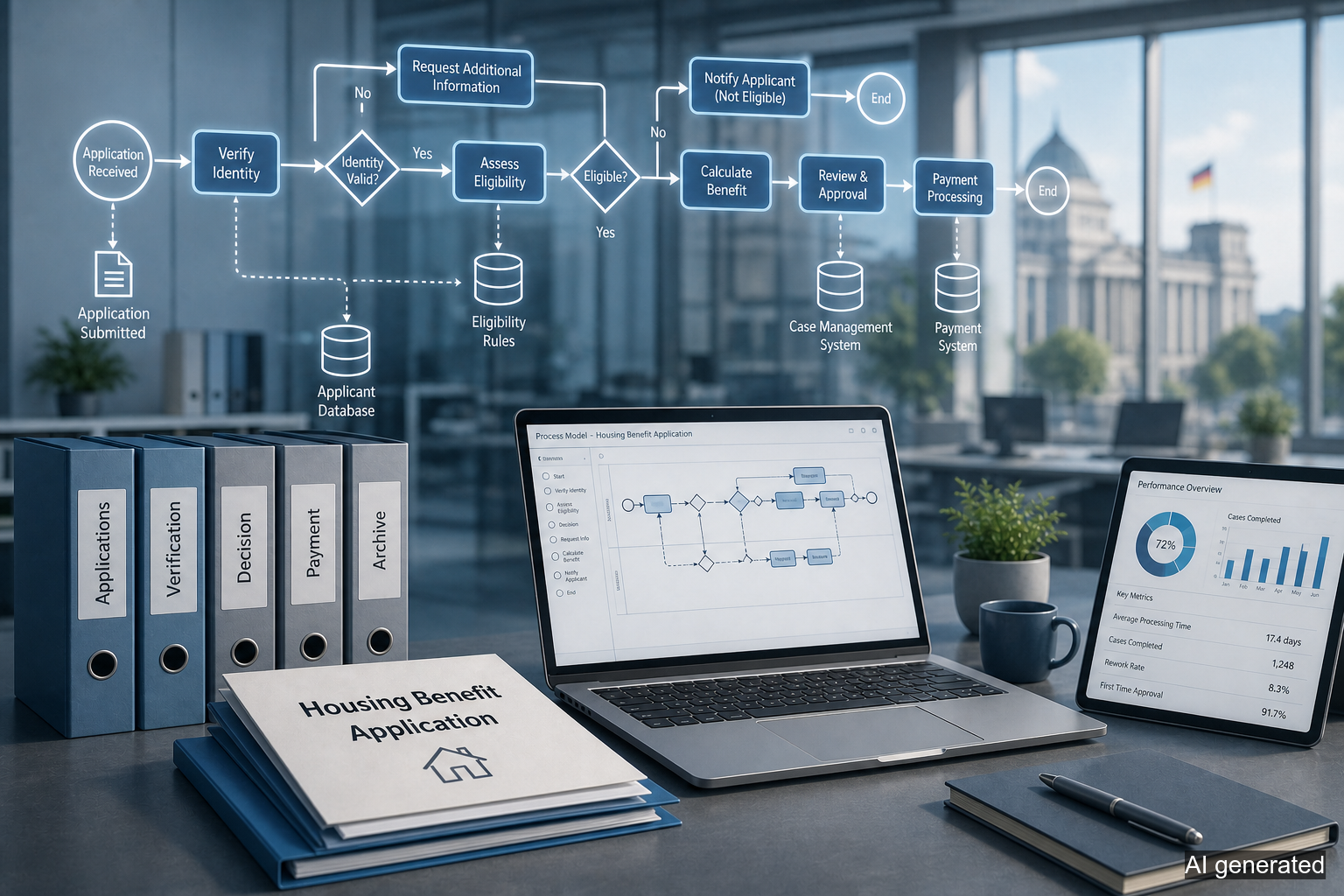
Process intelligence describes a government’s ability to make its processes transparent, analyze them based on data, and then steer and automate them accordingly. BPMN 2.0 is the key process language for this in the German public sector and is used in an adapted form within the FIM methodology (Föderales Informationsmanagement/Federal Information Management) (FITKO, 2013, Federal Office of Administration, 2024).
Starting Point: Process Documentation Without Process Intelligence
Many public organizations document their processes in manuals, administrative orders, or textual process descriptions that are often fragmented, hard to find, out of date, and not machine-readable (Federal Ministry of the Interior and Community, 2025). As a result, processes can neither be automatically analyzed nor linked to meaningful metrics, nor can they be used directly as a basis for IT implementations (FITKO, 2019).
Media breaks, long throughput times, and inconsistent processing paths remain invisible without standardized process modeling. Model-based descriptions using BPMN 2.0 and FIM-BPMN change that by translating business processes into a formally defined language that is understood across organizations (FITKO, 2013, Heitkötter et al., 2010).
What Exactly Is BPMN 2.0?
BPMN (Business Process Model and Notation) is a standard for graphical business process modeling developed by the Object Management Group (OMG), and has been internationally standardized as ISO/IEC 19510:2013 since 2013 (FITKO, 2013). A BPMN model describes processes using a defined set of symbols and elements, including:
- Activities (tasks) for business work steps
- Events for process start, intermediate events, and process end
- Gateways for data- or event-based decisions and branching
- Sequence flows for the logical order of process steps
- Lanes and pools for roles and organizational units
Unlike simple flowcharts, a BPMN model is formally defined, standardized, and machine-readable. In suitable tools, it can be validated, analyzed, and executed in a process engine, which allows business models to serve directly as a foundation for technical implementations (Federal Office of Administration, 2024).
Why BPMN Is the De Facto Standard in the German Public Sector
The Federal Office of Administration (Bundesverwaltungsamt, BVA) has established BPMN 2.0 as a binding standard in the federal government’s process management toolset and has operationalized it using best-practice guidelines, a conventions handbook, and an attribute catalog (Federal Office of Administration, 2024). At the same time, the FIM methodology defines a public sector-specific specialization of BPMN 2.0 (FIM-BPMN) that restricts the notation to a curated symbol set and introduces modeling conventions (FITKO, 2013, FITKO, 2019).
A Shared Language Between Business and IT
BPMN enables subject-matter experts to describe their processes precisely without needing programming skills, while IT departments can use the same models to derive workflows, interfaces, and configurations for line-of-business applications (Federal Office of Administration, 2024). This creates a shared process language that reduces misunderstandings and increases the traceability of implementation decisions (Federal Ministry of the Interior and Community, 2025).
Cross-Agency Standardization with FIM-BPMN
Within the FIM methodology, core processes are modeled using FIM-BPMN. Here, the use of BPMN 2.0 is restricted to a defined set of allowed elements to ensure a consistent level of detail and high reusability of process models (FITKO, 2013, FITKO, 2019). This enables federal, state, and local governments to exchange process models and systematically support reuse (PICTURE GmbH, 2021).
Foundation for Automation and OZG Implementation
Implementation of the German Online Access Act (Onlinezugangsgesetz, OZG), workflow platforms, RPA scenarios, and AI-supported case handling all depend on clearly defined, reusable process models. BPMN and FIM-BPMN models provide this foundation by describing automation paths, interfaces, and data flows in a way that is explicit and auditable (FITKO, 2019, Federal Office of Administration, 2024).
Core BPMN 2.0 Elements in Everyday Public Sector Use
The following basic elements appear in virtually every public sector process and are clearly defined in the FIM-BPMN building blocks (FITKO, 2013):
| Element | Meaning in public sector processes |
|---|---|
| Start event (circle) | Triggers a case, e.g., receipt of an application. |
| End event (bold circle) | Closes the case, e.g., dispatch of a notice. |
| Task (rectangle) | Concrete processing step performed by a role. |
| Exclusive gateway (diamond with X) | Either-or decision, such as completeness “yes/no”. |
| Parallel gateway (diamond with +) | Parallel execution of multiple subprocesses. |
| Lane | Responsibility area, e.g., case worker, team lead. |
| Pool | Organizational unit, e.g., department or agency. |
In FIM-BPMN, these elements are further refined by modeling conventions, for example regarding task naming, pool structure, and representation of data objects and data stores (FITKO, 2013, Federal Office of Administration, 2024).
Practice Example: Housing Benefit Application as a BPMN Model
A typical housing benefit (Wohngeld) application can be modeled using BPMN and FIM-BPMN as follows (Federal Ministry of the Interior and Community, 2025):
- Start event: Application received via online portal or paper mail.
- Task: Formal completeness check performed by the case worker.
- Exclusive gateway: Is the application complete? If “no”, request missing documents; if “yes”, proceed to the substantive review.
- Task: Substantive review of eligibility criteria.
- Task: Calculation of the housing benefit amount.
- Task: Drafting and dispatch of the decision notice.
- End event: Case closed; relevant data are transferred to core systems and statistics.
Such a model does more than visualize the process. It provides a basis for measuring throughput times, identifying bottlenecks, and systematically designing automation steps—for example, automated completeness checks or automated decision drafting (FITKO, 2019, PICTURE GmbH, 2021).
Levels of Maturity in BPMN Use in Government
From a process intelligence perspective, BPMN usage can be grouped into three maturity levels, each with distinct requirements for methodology, governance, and technology (Federal Office of Administration, 2024, FITKO, 2019):
Maturity Level 1 – Documentation
Processes are modeled using BPMN or FIM-BPMN to achieve transparency and knowledge retention. Models are broadly conformant with FIM and BVA conventions but are used mostly in a static way—for instance, for training or for documenting OZG service processes (Federal Ministry of the Interior and Community, 2025).
Maturity Level 2 – Optimization
BPMN models are actively analyzed, linked to metrics, and transformed into target-state process models. The conventions handbook, best-practice guides, and FIM quality criteria function as a reference framework for systematic process improvement (Federal Office of Administration, 2024, FITKO, 2019). Process intelligence at this level emerges from connecting models, measurement, and management decisions.
Maturity Level 3 – Automation
At maturity level 3, BPMN models form the foundation for executable workflows in process engines, automated interfaces, and combined use of RPA and AI. Changes in process design are propagated in a controlled, versioned, and auditable way into technical execution (Federal Office of Administration, 2024, PICTURE GmbH, 2021). Many agencies currently operate between level 0 (no standardized modeling) and level 1, which means optimization and automation potentials are far from being fully leveraged (Federal Ministry of the Interior and Community, 2025).
Typical Pitfalls in Introducing BPMN
Experience reports from federal and state administrations show recurring challenges when introducing BPMN and FIM-BPMN (Federal Office of Administration, 2024):
- Excessive detail too early: Instead of starting with end-to-end views, organizations immediately model subprocesses at a very granular level and lose sight of the overall process.
- Treating BPMN as a pure IT project: Modeling is moved into technical projects instead of being led by the business and owned by process owners.
- Missing governance: There are no clearly defined roles for process ownership, quality assurance, convention management, and training.
- Models without a usage concept: BPMN models are created but not systematically used for OZG implementation, KPI systems, training, or automation.
A successful BPMN rollout combines methodology (FIM-BPMN, conventions handbook), governance (roles, responsibilities), and technology (tools, process engines) into a coherent overall system (Federal Office of Administration, 2024, FITKO, 2019).
Conclusion: BPMN as an Infrastructure Building Block for Process Intelligence
BPMN 2.0—operationalized in the public sector through FIM-BPMN and BVA conventions—is more than just a modeling standard. It is an infrastructure building block for process intelligence: processes become transparent, comparable, and measurable; improvements can be planned based on facts; and automation becomes manageable and aligned with OZG and broader digital transformation programs (FITKO, 2019, Federal Office of Administration, 2024).
Anyone talking seriously about digital government is, sooner or later, talking about BPMN— as a shared language between business and IT and as a foundation for scalable, intelligent process landscapes (FITKO, 2013, Federal Ministry of the Interior and Community, 2025).
Related Articles
- Process-Oriented Thinking vs. Department-Oriented Thinking: Why the Administration Needs to Fundamentally Change Its Mindset
- Federal Information Management (FIM): The Underrated Standard of Public Sector Digitalization
- Process Automation in Administration: A Comparison of RPA, Low-Code, and Workflow Engines
References
- Federal Office of Administration. (2024). Best practices in BPMN modeling – basics (Version 1.0). Competence Center for Process Management – Standards and recommendations for a uniform federal process management. https://www.bva.bund.de/SharedDocs/Downloads/DE/Behoerden/Beratung/Prozessmanagement/PMT/Best_Practices_PMT.pdf
- FITKO. (2013). FIM-BPMN: Modeling core processes with BPMN 2.0. Federal development portal.
https://docs.fitko.de/fim/docs/prozesse/fachkonzept/prozessbaukasten/fim-bpmn - FITKO. (2019). FIM portal: Federal Information Management – Processes. https://docs.fitko.de/resources/fim/
- Federal Ministry of the Interior and Community. (2025). Organizational handbook of the federal government: Capturing and documenting process flows. https://www.orghandbuch.de/
- PICTURE GmbH. (2021). Modeling and reusing FIM processes with the PICTURE process platform. PICTURE GmbH. https://www.picture-gmbh.de/
- Heitkötter, H., Zeller, V., & Becker, J. (2010). Transforming PICTURE to BPMN 2.0 as part of model-driven development in public administration. In Proceedings of the Workshop on Method Engineering.
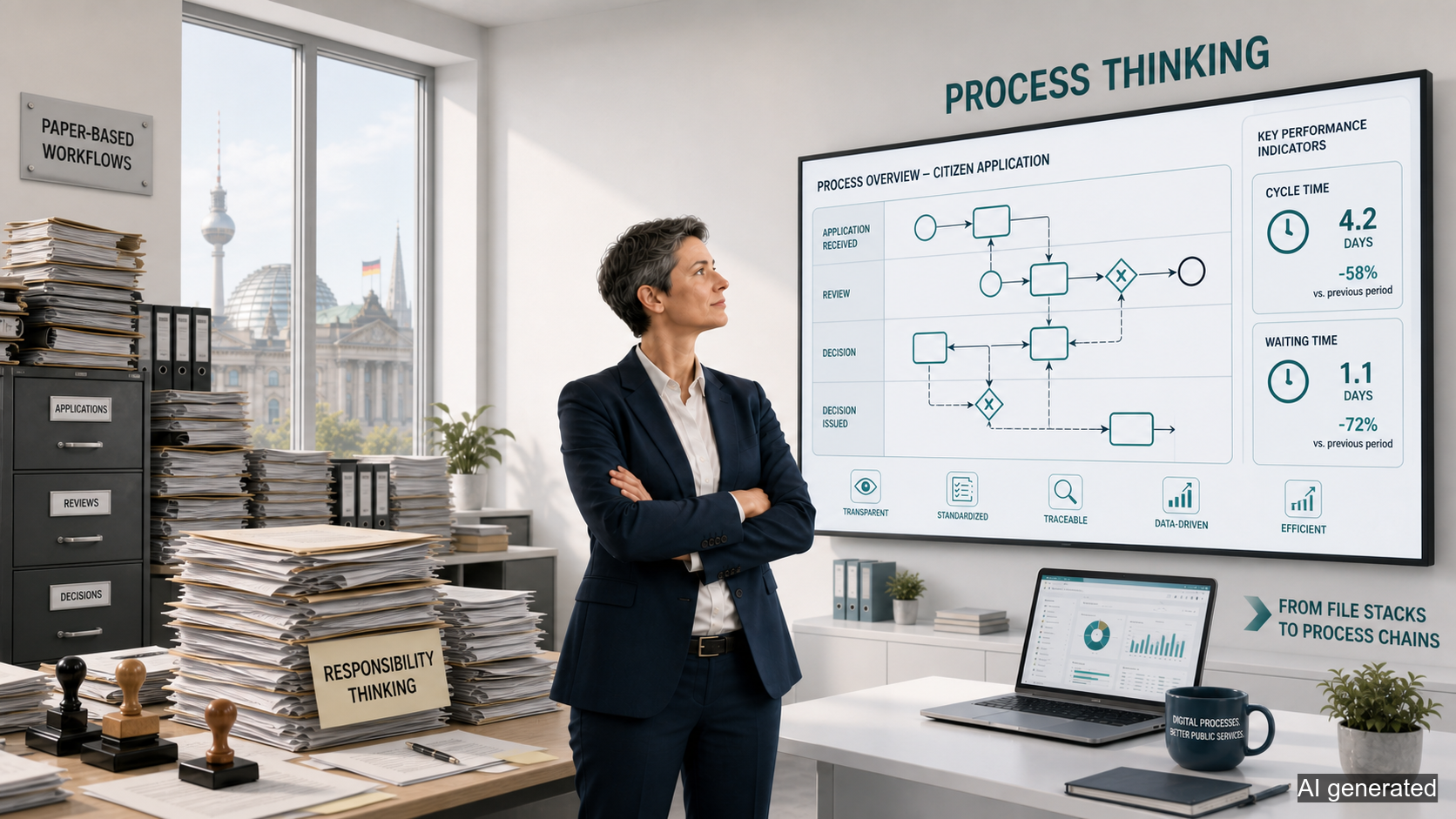
Digitalization in German public administration does not primarily fail because of missing technology, but to a considerable extent because processes are poorly coordinated, only partially standardized, and rarely thought through end-to-end. Looking at organizational charts and departmental responsibilities is therefore not sufficient; what is needed is a process-oriented perspective that understands administrative services as end-to-end value chains. This line of argument can be anchored theoretically in business process management (BPM), business process reengineering (BPR), and a socio-technical view of administrative organizations (vom Brocke & Rosemann, 2015; Hammer & Champy, 1993; Davenport, 1993).
The Core Problem: Responsibility Instead of Flow
Public administrations have historically been organized primarily along functional lines of responsibility. This structure secures formal accountability, but at the same time it reinforces media breaks, redundant checks, sequential handovers, and a lack of transparency regarding the actual processing status of a case. For applicants, it is often unclear where a procedure currently resides, which office is working on it, and at which interface delays arise.
From a process perspective, this fragmentation is the central organizational problem. While responsibility thinking focuses on formal accountability, compliance with rules, and handing the case to the “next competent unit,” process thinking focuses on the entire case flow – on sequence, dependencies, information needs, waiting times, and output quality. Process management does not replace responsibilities; it complements them with a coordinating end-to-end perspective (vom Brocke & Rosemann, 2015; Drobits et al., 2024).
Theoretical Framing
In the BPM literature, a business process is defined as a structured sequence of interrelated activities that transforms inputs into outputs and thereby creates value for internal or external recipients. Applied to public administration, this means: a process does not start at the internal desk of a caseworker, nor does it end with forwarding the case to another unit. It begins with the initial input and only ends when the service has been fully delivered to citizens or businesses (vom Brocke & Rosemann, 2015).
Three theoretical lenses are particularly relevant. First, BPM provides the conceptual framework for identifying, modeling, analyzing, executing, and continually improving processes. Second, BPR emphasizes that digitalization delivers substantial benefits only when processes are not merely reproduced electronically but fundamentally simplified and redesigned. Third, a socio-technical perspective highlights that sustainable administrative digitalization cannot be understood as an IT project alone, but rather as an interplay of organization, rules, roles, technologies, and institutional incentives (Hammer & Champy, 1993; Davenport, 1993; Barriers to Business Process Innovation in Public Service Organizations, 2024).
Responsibility Thinking vs. Process Thinking
- Responsibility thinking asks: Who is formally in charge, which office processes the case next, and are internal rules and instructions being followed?
- Process thinking asks: What must happen next to achieve the procedural goal, which information is needed, and where do delays, redundancies, or error sources occur?
- Organizational implication: Responsibility orientation optimizes partial tasks within silos; process orientation optimizes the overall flow across organizational boundaries.
- Digitalization implication: If only responsibilities are digitized, existing inefficiencies are reproduced in digital form. Only process-oriented design creates the precondition for effective digitalization (Hammer & Champy, 1993; Davenport, 1993).
Why Digitalization Fails at This Point
Empirical evidence on administrative digitalization in Germany supports this diagnosis. The Behörden-Digimeter 2026 shows that, as of early 2026, only 823 of 7,509 relevant individual services were implemented nationwide; at the same time, no federal state had more than 291 of 577 Onlinezugangsgesetz (OZG) service bundles fully available. The study explicitly emphasizes that this implementation status does not yet reflect a deep digitalization of the underlying administrative processes (Büchel et al., 2026).
The Fraunhofer FOKUS study EfA im Fokus points to structural barriers that are not primarily technical either. The study shows that municipalities still face financial uncertainty, high support needs, complex procurement requirements, and heterogeneous organizational structures when reusing “Einer-für-Alle” digital services. It particularly highlights the need for stronger coordination, knowledge transfer, reliable rollout structures, and transparent process management (Rother et al., 2025).
These findings make it clear: the deficit is not just a lack of online services, but poorly coordinated and institutionally weak process chains. Digitalization without prior process analysis therefore tends to reproduce existing inefficiencies in digital form instead of removing them (Davenport, 1993; Hammer & Champy, 1993).
What an Administrative Process Actually Includes
In public administration, a process typically consists of a defined input, a sequence of rule-based and professional activities, and a clearly identifiable output. Inputs might be applications, notifications, or events such as birth, relocation, or business formation. Activities range from examination, decision-making, and documentation to clarification requests, involvement of other units, and delivery of decisions. Outputs are permits, notices, registry entries, or other administrative acts.
Crucially, all internal handovers, idle times, and feedback loops are part of the process. These invisible in-between spaces are often the true sources of delay, opacity, and friction. From a BPM perspective, the primary analytical object is therefore not the individual processing step but the complete end-to-end process (vom Brocke & Rosemann, 2015; Drobits et al., 2024).
Three Dimensions of the Required Shift
From Function to Flow
Administrative modernization must model cases as coherent flows rather than as a chain of responsibilities. At the federal level, BPMN 2.0 has been established as a key modeling standard; the Federal Office of Administration emphasizes that uniform process management standards enable processes to be steered and documented consistently using BPMN 2.0 (Bundesverwaltungsamt, 2023; Bundesverwaltungsamt, 2024).
From Exception to Rule
Process thinking looks for recurring patterns and standardizable case constellations. In public administration, a substantial share of cases can be structured by explicit decision rules, while complex exceptions are treated separately. The Federal Office of Administration describes DMN expressly as a standard for modeling business rules and decision processes; this facilitates transparent documentation of standard decisions and, where legally and organizationally feasible, their technical support (Bundesverwaltungsamt, 2025a; Bundesverwaltungsamt, 2025b).
From Silos to Process Chains
The greatest sources of friction typically arise at interfaces between organizational units, federal levels, and IT service providers. The Fraunhofer FOKUS study underlines the need for stronger coordination, intermediary actors, standardized handover structures, and audience-appropriate communication in the EfA rollout. Process thinking is therefore always also interface management: it makes handovers visible, reduces unnecessary loops, and strengthens coordination across departmental and jurisdictional boundaries (Rother et al., 2025).
Organizational Preconditions
A process-oriented administration requires, first, visibility through documented and modeled processes. Second, it needs accountability through process owners or similar roles holding a cross-unit mandate. Third, it requires measurability – metrics like on throughput times, idle times, clarification requests, error rates, and variant frequencies. These three preconditions are primarily organizational and governance-related, not technical (Drobits et al., 2024; Barriers to Business Process Innovation in Public Service Organizations, 2024). It is important to note that these key figures are both purpose-driven and economically measurable.
This leads to an often underestimated insight: technology cannot compensate for a lack of process clarity. If roles, rules, handovers, and escalation mechanisms remain vague, digital technology at best accelerates existing dysfunctions. From a BPM perspective, process analysis is therefore not a downstream optimization step, but the precondition for any meaningful digitalization (Davenport, 1993; vom Brocke & Rosemann, 2015).
Implications for Leadership and Governance
Process thinking is not neutral, because it reduces organizational opacity. Once throughput times, idle times, and handovers become visible, responsibility diffusion, duplicate work, and avoidable delays are exposed. This helps explain why process-oriented reforms regularly encounter not only professional but also political and micro-political resistance (Barriers to Business Process Innovation in Public Service Organizations, 2024).
For leadership, this means that process management must be understood as a governance task. It is not sufficient to provide modeling standards or online services; leadership must also ensure prioritization, mandate, standardization, and enforcement across organizational boundaries. Particularly in federal systems, coordination quality matters more for digital transformation success than the mere availability of individual technologies (Rother et al., 2025; Büchel et al., 2026).
Conclusion
Process thinking is not software, but an organizational lens on administrative service delivery. Approaching digitalization mainly as the deployment of digital front ends misses the core modernization challenge. Only when administrations model, standardize, measure, and steer their services as end-to-end processes do the conditions emerge for effective, scalable, and user-centered digitalization (vom Brocke & Rosemann, 2015; Drobits et al., 2024).
Related Articles
- Process Intelligence: The Missing Foundation for Administrative Digitization and AI
- What is BPMN – and Why Does Government Need This Method?
- Process Management Maturity: Where Does Your Agency Stand—and What's Next?
References
- Barriers to business process innovation in public service organizations. (2024). Information Systems and Informatics Journal, 6(3). https://doi.org/10.51519/journalisi.v6i3.858
- Büchel, J., Gruben, C. F., & Röhl, K.-H. (2026). Behörden-Digimeter 2026: E-Government und Verwaltungsdigitalisierung: Aktueller Status quo und die Maßnahmen der Bundesregierung seit ihrem Amtsantritt. Institut der deutschen Wirtschaft. https://www.iwkoeln.de/fileadmin/user_upload/Studien/Gutachten/PDF/2026/Beh%C3%B6rden-Digimeter_2026.pdf
- Bundesverwaltungsamt. (2023, October 5). Der Attributkatalog für BPMN 2.0. https://www.bva.bund.de/SharedDocs/Downloads/DE/Behoerden/Beratung/Prozessmanagement/PMT/Attributkatalog_PMT.html
- Bundesverwaltungsamt. (2024). Standards und Empfehlungen für ein bundeseinheitliches Prozessmanagement. https://www.bva.bund.de/DE/Services/Behoerden/Beratung/BZB/Themenwelten/Prozesse/Prozessmanagement/PMT/PMT_node.html
- Bundesverwaltungsamt. (2025, January 22). 1. Schritt: Wozu DMN? Die Grundlagen. https://www.bva.bund.de/DE/Services/Behoerden/Beratung/Beratungszentrum/CCPM/Tutorialreihe_Modellierungsnotationen/DMN/stda_Schritt1_DMN_node.html
- Bundesverwaltungsamt. (2025, January 27). Modellieren mit ArchiMate, DMN und CMMN: Tutorialreihe veröffentlicht. https://www.bva.bund.de/DE/Services/Behoerden/Beratung/BZB/Themenwelten/Prozesse/Prozessmanagement/Meldungen/Aktuelles/2025/Veroeffentlichung_Tutorialreihe_MN.html
- Davenport, T. H. (1993). Process innovation: Reengineering work through information technology. Harvard Business School Press.
- Drobits, M., Stelzl, K., & Wimmer, M. A. (2024). Business process management in the public sector: A systematic literature review. Business Process Management Journal. Advance online publication.
- Hammer, M., & Champy, J. (1993). Reengineering the corporation: A manifesto for business revolution. Harper Business.
- Rother, A., Hecht, S., & Plomin, J. (2025). EfA im Fokus: Studie zur Organisation der kommunalen Nachnutzung von EfA-Leistungen und der Nutzung des EfA-Marktplatzes. Fraunhofer FOKUS. https://www.fokus.fraunhofer.de/content/dam/fokus/dokumente/dps/studie-paper/202504_Fraunhofer_FOKUS_EfA_im_FOKUS.pdf
- vom Brocke, J., & Rosemann, M. (Eds.). (2015). Handbook on business process management 1: Introduction, methods, and information systems (2nd ed.). Springer. https://doi.org/10.1007/978-3-642-45100-3

Executive Summary
Digital transformation in German public administration fails less due to a lack of technology than because administrative processes are insufficiently understood, documented, and managed. Process intelligence—understood as the public sector’s ability to systematically capture its processes, analyze them in a data-driven way, steer them in a targeted manner, and continuously improve them—forms the operational foundation of effective digitalization and responsible AI use.
Conceptually, process intelligence builds on established Business Process Management (BPM) but extends it through data-driven analysis and AI-enabled decision mechanisms (Dumas et al., 2018). From a design science perspective, process intelligence can be understood as a socio-technical artifact that integrates organizational structures, methods (e.g., BPMN, DMN, process mining), and technical systems in order to address the problem of fragmented digitalization in public administration (Hevner et al., 2004).
1. The Challenge of Digitalizing Public Administration
1.1 Digitalization without Process Reform
Digitalization initiatives in the public sector often focus on the technical implementation of existing procedures. In practice, this means that analog inefficiencies—such as redundant checks, media discontinuities, or unclear responsibilities—are transferred unchanged into digital systems. The result is digitized legacy processes instead of structural improvements, as documented in the e-government literature on fragmented modernization approaches (Janssen & Cresswell, 2006).
Effective digitalization therefore requires prior analysis and redesign of the underlying processes, as formalized in the BPM lifecycle phases of process analysis and process redesign (Dumas et al., 2018).
1.2 Structural Root Causes
- Fragmented IT landscapes: A lack of interoperability prevents end-to-end process logic and hinders an end-to-end view of public services (Janssen & Cresswell, 2006).
- Low standardization: Similar services are implemented differently across organizations; this undermines the scaling and re-use of digital solutions (Scholta et al., 2019).
- Responsibility-oriented structures: Processes are designed along organizational units rather than end-to-end process chains, which public management research describes as a major barrier to process reform (Bouckaert & Halligan, 2008).
- Front-end focus: Digitalization often targets citizen-facing touchpoints rather than internal core processes, thereby limiting potential efficiency and quality gains (Janssen & Cresswell, 2006).
1.3 AI as an Amplifier of Structural Deficits
AI systems strongly depend on clearly defined processes and consistent data structures. Studies on algorithmic decision support in public administration show that unclear decision rules and heterogeneous data sets lead to bias, opacity, and limited scalability (Veale & Brass, 2019). In environments characterized by high process variance, unclear decision rules, and low data quality, AI solutions reinforce existing inefficiencies instead of compensating for them.
2. The Concept of Process Intelligence
2.1 Definition and Positioning in the IS Discourse
Process intelligence describes an organization’s ability to understand, manage, and adaptively further develop its business processes on a data-driven basis. It thus stands in the tradition of BPM, which the IS and management literature describes as a holistic approach to identifying, modeling, analyzing, improving, and automating processes (Dumas et al., 2018). At the same time, process intelligence addresses the “missing link” problem between information systems and actual process execution that is emphasized in the process mining discourse (van der Aalst, 2016).
In the sense of Design Science Research, process intelligence can be conceptualized as an integrated artifact that brings together methods (BPMN, DMN, process mining), organizational roles (process owners, governance bodies), and technical infrastructure (process-capable line-of-business systems, event logs) in order to address a clearly defined relevance problem—the stagnation of digitalization in public administration (Hevner et al., 2004).
2.2 Levels of Process Intelligence
- Transparency: Systematic capture and modeling of as-is processes, typically using BPMN 2.0 and process screenings.
- Analysis: Data-driven assessment of efficiency, quality, and variants, for example using KPI systems and process mining techniques (van der Aalst, 2016).
- Steering: Continuous optimization, automation, and integration of AI applications, supported by explicit decision models (DMN) and governance structures.
3. Methodological Foundation: Artifact Building Blocks
From a DSR perspective, process intelligence consists of an ensemble of artifact building blocks—conceptual models, methods, and technical components—that jointly enable a process-intelligent public administration (Hevner et al., 2004).
3.1 Process Screening
Process screening is the starting point and serves to systematically capture, prioritize, and assess administrative processes. It operationalizes the process identification and documentation phases in the BPM lifecycle and creates a sound basis for subsequent design and evaluation steps Dumas et al., 2018.
3.2 BPMN 2.0 as a Process Language
BPMN 2.0 enables standardized and cross-organizationally comprehensible process modeling and is established in the IS literature as the de facto standard for process modeling (Dumas et al., 2018). For public administration, BPMN creates the precondition for integrating business and technical perspectives on administrative workflows and for supporting model-based automation approaches.
3.3 FIM as a Federal Standardization Framework
The Federal Information Management (FIM) framework complements BPMN with public sector–specific structuring of services, data, and processes. It operationalizes the idea of standardization, which the digital government literature highlights as a prerequisite for cross-organizational re-use and scaling (Scholta et al., 2019).
3.4 DMN for Modeling Decision Logic
Decision Model and Notation (DMN) enables explicit, formally structured representation of decision rules. From an AI governance perspective, DMN provides a transparent foundation for rule-based and AI-supported decisions and is crucial for the traceability and auditability of algorithmically supported administrative decisions (Veale & Brass, 2019).
3.5 Process Mining as Data-Driven Analysis
Process mining closes the gap between modeled to-be processes and real as-is executions by using event data (event logs) to reconstruct actual process variants, bottlenecks, and compliance deviations (van der Aalst, 2016). For public administration, process mining provides the empirical basis on which process intelligence can evolve from a purely model-driven approach into a data-driven capability for process steering.
4. Process Intelligence as a Precondition for AI in Public Administration
4.1 Design Relevance: Why AI Fails without Process Intelligence
From the perspective of the DSR relevance criterion, process intelligence addresses a clearly defined practical problem: AI pilot projects in public administration often remain isolated, non-scalable, and difficult to explain. The literature on algorithmic decision-making in the public sector points in particular to poor data quality, unclear decision logic, and weak governance structures as key causes Veale & Brass, 2019.
4.2 Maturity Model as a Conceptual Artifact
The outlined maturity model (from “ad hoc” to “AI-ready”) can be understood as a conceptual artifact in the sense of Hevner et al., 2004. It structures the development paths of public organizations and makes it possible to plan and evaluate design decisions along defined maturity levels (documentation, standardization, data-drivenness, AI integration).
- Ad hoc: Undocumented processes, no consistent view of workflows.
- Documented: Modeled processes, but not firmly institutionalized.
- Standardized: Binding process models, clear roles and governance.
- Data-driven: Continuous measurement, monitoring, and improvement.
- AI-ready: Integration of AI systems into stable, standardized, and data-driven process landscapes.
5. Impact Potential and Evaluation
5.1 Efficiency, Quality, and User Orientation
Empirical studies on BPM show that structured process design and management lead to measurable gains in efficiency and quality, for example in the form of shorter throughput times, lower error rates, and improved service quality (Dumas et al., 2018). In a DSR setting, these metrics can serve as evaluation criteria for process intelligence artifacts.
5.2 Transparency, Legal Certainty, and AI Governance
Explicit process and decision models increase traceability, auditability, and legal certainty—a core requirement in the public sector. In the debate on “algorithmic accountability,” it is emphasized that transparent decision rules and documented workflows are prerequisites for legitimate AI-supported decisions (Veale & Brass, 2019).
5.3 Scalability and Re-use
Standardized models following FIM and BPMN logic support the “one-for-all” principle, which the German-speaking e-government discourse views as key to scaling digital public services (Scholta et al., 2019). From a DSR perspective, this represents an important criterion for the broad impact of the artifact.
5.4 Adaptability and Resilience
Documented and standardized processes facilitate the implementation of regulatory changes and organizational adjustments. The public administration and public management literature discusses this as a central dimension of administrative resilience and change capability (Bouckaert & Halligan, 2008).
6. Implications for Design Science Research
6.1 The Artifact Nature of Process Intelligence
Process intelligence can be understood as a comprehensive socio-technical artifact in the sense of Hevner et al., 2004. It combines conceptual models (maturity model, levels of process intelligence), methods (screening, BPMN, DMN, process mining), and technical implementations (event-based system logs, workflow systems) and thus addresses a key relevance problem of administrative digitalization.
6.2 Research Design and Evaluation Paths
For a DSR paper, formative evaluations along the maturity levels and summative evaluations using metrics for efficiency, quality, transparency, and scalability are particularly suitable (Hevner et al., 2004). In addition, applying the Hevner guidelines to process intelligence artifacts themselves can become the subject of a conceptual or empirical study (Gregor & Hevner, 2013).
7. Conclusion
Process intelligence is a central precondition for successful digitalization of public administration and scalable AI deployment. In the IS discourse, it links BPM, process mining, and AI governance into an integrated, design-oriented approach that addresses the relevance problem of fragmented and technology-driven digitalization initiatives (Dumas et al., 2018, van der Aalst, 2016). As an artifact in the sense of design science, process intelligence offers a structured framework for integrating and systematically evaluating process, data, and AI perspectives in public administration (Hevner et al., 2004).
Literature
- Hevner, A. R., March, S. T., Park, J., & Ram, S. (2004). Design science in information systems research. MIS Quarterly, 28(1), 75–105.
- Gregor, S., & Hevner, A. R. (2013). Positioning and presenting design science research for maximum impact. MIS Quarterly, 37(2), 337–355.
- Dumas, M., La Rosa, M., Mendling, J., & Reijers, H. A. (2018). Fundamentals of business process management (2nd ed.). Springer. https://doi.org/10.1007/978-3-662-56509-4
- van der Aalst, W. (2016). Process mining: Data science in action (2nd ed.). Springer.
- Janssen, M., & Cresswell, A. M. (2006). Enterprise architecture integration in e-government. Proceedings of the 39th Annual Hawaii International Conference on System Sciences. IEEE.
- Scholta, H., Mertens, W., Kowalkiewicz, M., & Becker, J. (2019). From one-size-fits-all to user-centered digital public services: A literature review and research agenda. Government Information Quarterly, 36(1), 11–25.
- Bouckaert, G., & Halligan, J. (2008). Managing performance: International comparisons. Routledge.
- Veale, M., & Brass, I. (2019). Administration by algorithm? Public management meets public sector machine learning. Public Management Review, 21(4), 615–642.
