

Fragmentation as a Structural Problem
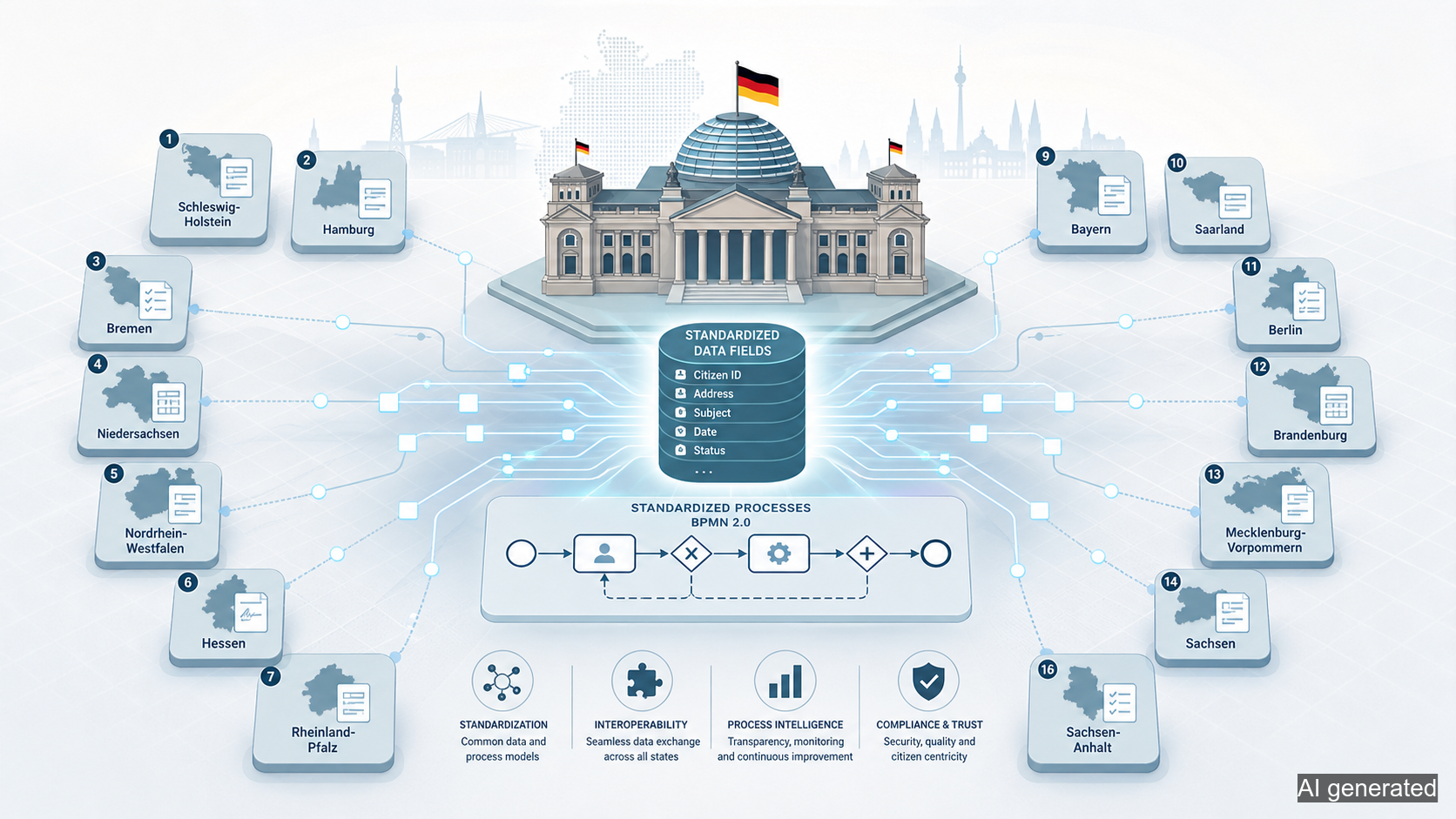
In Germany, the same public service—such as a building permit—exists in 16 different variants across the federal states: varying forms, divergent review steps, and heterogeneous IT systems. This fragmentation is not primarily a technical issue, but the result of missing standardization at semantic, procedural, and domain levels.
From an information systems perspective, this represents a classic interoperability problem in federal socio-technical systems. Without shared reference models, isolated solutions emerge that are neither scalable nor efficiently integrable, as highlighted by the European Interoperability Framework European Commission, 2017.
FIM as a Standardization Framework
Federal Information Management (FIM) addresses this problem as a methodological standardization approach. Its goal is to develop reusable, structured descriptions of public services as a foundation for digitalization and automation BMI, 2021.
Conceptually, FIM can be understood as a reference model in the sense of Design Science Research: a socio-technical artifact that enables semantic interoperability and forms the basis for reusable digital services.
The Three Components of FIM
- Service Descriptions (FIM-L): Standardized, legally grounded descriptions of public services, including eligibility criteria, deadlines, and legal bases BMI, 2021.
- Data Fields (FIM-D): Uniformly defined data structures describing the information collected in administrative procedures, forming the basis for register integration and the once-only principle BMI, 2021.
- Processes (FIM-P): Standardized process models, typically in BPMN 2.0, describing service delivery workflows and enabling cross-organizational reuse BMI, 2021.
FIM in the European Context
FIM is embedded in broader European interoperability initiatives. In particular, the once-only principle, as defined in the Single Digital Gateway Regulation (SDGR), requires that data be standardized and unambiguously interpretable European Union, 2018.
This is where FIM-D becomes critical: only semantically harmonized data fields enable automated, cross-register data exchange.
Architecture: Semantics, Syntax, Infrastructure
- Semantics: FIM-D defines meaning and structure of data (What data is collected?).
- Syntax and transport: XÖV standards define exchange formats and message structures (How is data transmitted?).
- Infrastructure: The National Once-Only Technical System (NOOTS) provides the platform for cross-register data exchange.
- Domain layer: FIM-L and FIM-P define services and processes (Why and how actions occur).
The NOOTS architecture, adopted in 2025, builds directly on FIM data definitions. Without semantic standardization, automated data exchange is technically feasible but not meaningfully interpretable—contradicting the core requirement of the once-only principle European Union, 2018.
FIM Maturity Model (Heuristic)
- Level 0: No structured process exists.
- Level 1: Processes are documented but not standardized.
- Level 2: FIM-compliant models exist and are reusable.
- Level 3: Processes are digitally executable and integrated.
- Level 4: Processes are largely automated (media disruption-free, once-only capable).
Common Implementation Challenges
- Governance: FIM is often treated as an IT initiative rather than a domain-driven standardization framework.
- Legal fragmentation: Differences in state-level legislation limit harmonization and reuse.
- Sustainability: Lack of governance leads to outdated models and declining relevance.
FIM as the Grammar of Digital Government
FIM acts as the semantic and procedural grammar of public sector digitalization. Without it, administrations digitize in isolated dialects that cannot interoperate.
The core challenge is not technological but institutional: achieving alignment and commitment to standardization before building software.
