Select your language


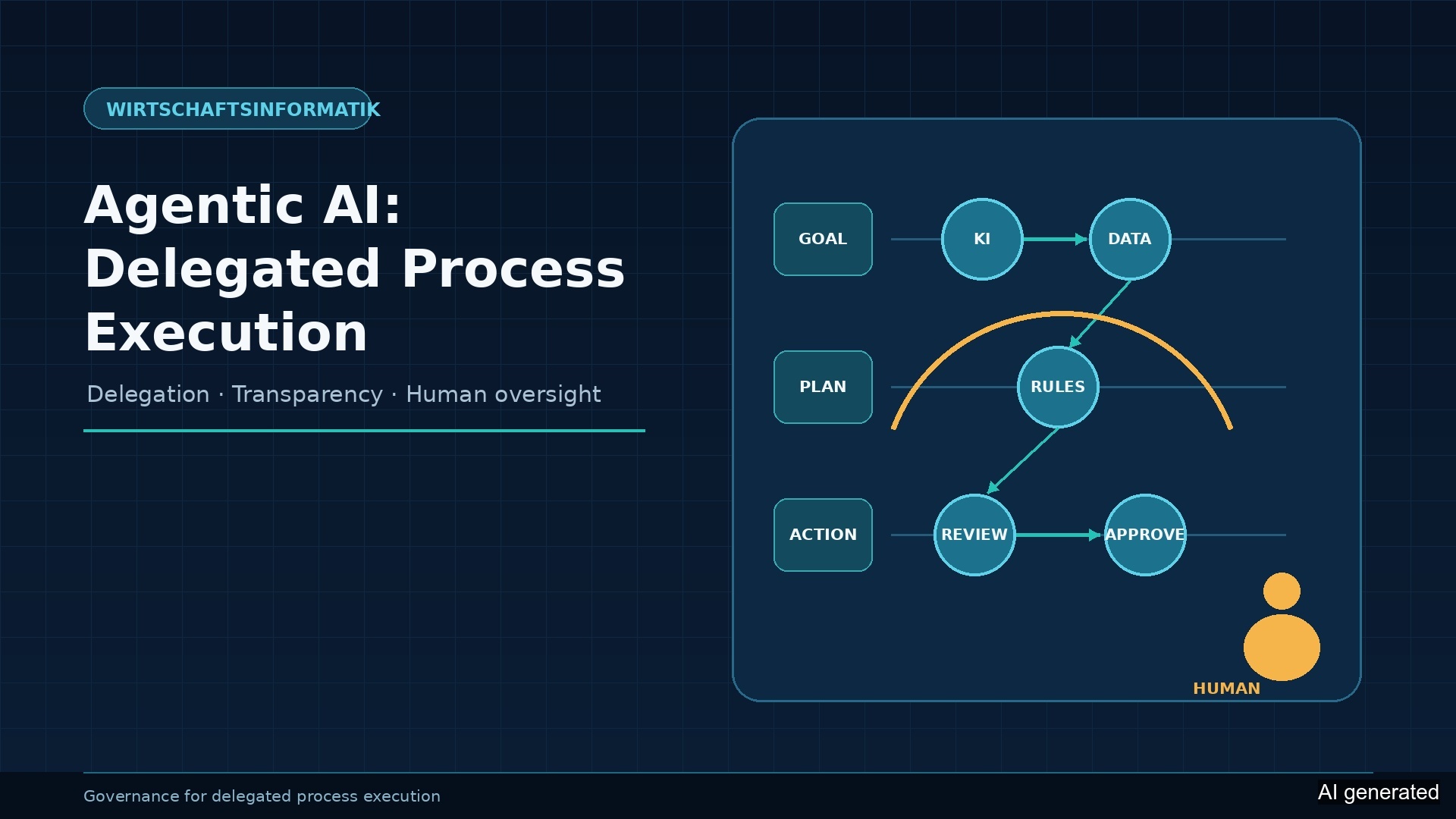
Generative artificial intelligence (AI) has rapidly become a widely used support technology. Initial attention focused primarily on applications that generate text, images, software code, or summaries. Increasingly, however, attention is shifting to systems that do more than produce individual pieces of content: they interpret goals, plan work steps, access data sources and digital tools, evaluate intermediate results, and initiate actions within defined limits. This development is commonly referred to as agentic AI.
For the information systems discipline, this development entails a shift in research priorities. The quality of individual AI outputs is no longer the sole focus. Instead, the central questions concern how tasks are allocated between people and AI systems, how decision-making and action authority can be constrained technically and organizationally, and how transparency, oversight, and accountability can be ensured in AI-enabled processes. Agentic information systems are therefore increasingly viewed as a distinct subject of research on delegation, coordination, governance, and human-AI collaboration (Holldack et al., 2026; Kumar et al., 2026).
What Is Agentic AI?
Agentic AI is neither a single technology nor a synonym for a large language model. Rather, the term refers to a class of AI-based systems that can independently plan and execute subtasks within predefined objectives, rules, and permissions. Typical capabilities include decomposing an objective into subtasks, selecting appropriate tools, accessing authorized information sources, evaluating intermediate results, and adapting a course of action when deviations or new information arise.
A conventional assistant system typically responds to a single prompt and produces, for example, a summary, a draft, or an analysis. An agentic system, by contrast, can manage a coherent process. For instance, it may review an application for completeness, consolidate information from multiple specialized systems, identify missing documents, prepare a draft request for additional information, submit a case for approval, and, after human confirmation, initiate further permissible process steps.
The central distinction, therefore, lies in delegated process execution. Users do not necessarily specify every individual action. Instead, they define objectives, rules, data access rights, tool permissions, quality requirements, and escalation mechanisms. The system is thereby granted limited technical discretion to act. However, this technical capacity for action must not be confused with human or organizational responsibility. An AI system may prepare or execute actions, but it cannot assume legal or moral responsibility.
Holldack, Banh, and Strobel distinguish agentic information systems from traditionally reactive information systems by their ability to make decisions, act in unstructured environments, and enable new forms of task delegation between people and systems (Holldack et al., 2026). This challenges the primary role of humans as the sole acting entities, which information systems research has often assumed, without transferring responsibility or legitimacy to technical systems.
From Tool to Process Actor
The introduction of agentic AI changes the design of digital work. While conventional information systems process data, provide information, or execute clearly defined transactions, agentic systems can assume parts of planning and coordination work. They do not become equal human actors; nevertheless, they become technically capable components of a sociotechnical work system.
This development can be understood as a transition from point-based assistance to structured delegation. The relevant question is no longer simply, “Can the system generate a good answer?” Equally important questions include: “Which tasks may be delegated?”, “Which actions require prior human approval?”, “How are decisions and tool calls documented?”, and “Who is responsible for the consequences when a system acts incorrectly or unexpectedly?”
Current discussion in behavioral information systems research suggests that AI is reshaping the research landscape along several dimensions. In addition to an agentic shift, in which systems prepare or execute actions, there is an epistemic shift driven by probabilistic and partly opaque system behavior, as well as a cognitive shift resulting from repeated use of AI-supported thinking and decision support (Grover & Tarafdar, 2026). For organizations, this means that the introduction of agentic AI should not be treated as an isolated IT project, but rather as a transformation of decision rights, capabilities, routines, and control structures.
Theoretical Perspectives
Information systems research provides several theoretical perspectives for examining agentic AI. Particularly relevant are the sociotechnical systems perspective, the task-technology fit approach, research on trust in automation, and perspectives on IT governance and accountability.
The sociotechnical systems perspective emphasizes that work performance does not result from technology alone. It depends on the interaction of people, tasks, data, technologies, rules, skills, and organizational routines. Agentic AI changes this configuration because it does not merely provide information; within defined limits, it plans, prioritizes, prepares, or executes tasks. The technical performance of a system is therefore only one condition of its value. Organizational embedding, the quality of underlying data, appropriate role models, and clearly defined escalation paths are equally important.
The task-technology fit approach demonstrates that information technology is particularly effective when its functionalities fit the characteristics of a task and the needs of its users (Goodhue & Thompson, 1995). In the context of agentic AI, this fit extends beyond a system’s technical ability to perform a task. It also concerns the appropriate degree of delegation. Routine, reversible, and readily verifiable activities may be largely automated. Decisions with significant consequences, limited reversibility, or strong contextual dependence, by contrast, require more stringent controls and approval mechanisms.
Research on trust in automation complements this perspective. Trust is not inherently positive; it must correspond to a system’s actual capabilities and limitations. Excessive trust can lead to the uncritical acceptance of system recommendations, while insufficient trust can prevent useful support from being used effectively. Lee and See refer to this as appropriate trust and appropriate reliance (Lee & See, 2004). This challenge is particularly pronounced in agentic AI because errors may not be limited to a single output but can propagate across multistep plans, data access operations, and tool calls.
Research and Design of Agentic Systems
Agentic AI opens up a broad field of research for information systems scholars. A design-oriented research approach is particularly suitable. Design science research aims to address relevant problems through innovative artifacts and to systematically evaluate their utility (Hevner et al., 2004). In the context of agentic AI, such artifacts may be technical, organizational, or hybrid design objects.
Examples include reference architectures for secure tool use, role and authorization concepts for AI agents, audit trails that document planning steps, patterns for risk-appropriate approvals, or procedures for classifying tasks according to their suitability for delegation. A design science research project could, for example, examine how an AI agent can conduct an initial review of applications in a public-sector administrative process, identify missing information, and prepare standardized requests for clarification without independently making legally binding decisions.
In addition to design science research, experimental designs and case studies are relevant. Experiments can be used to investigate, for example, the effects of different transparency or approval mechanisms on task quality, processing time, error detection, and trust. Case studies make it possible to examine the introduction of agentic systems in real organizational contexts. The focus then lies on changes in roles, routines, decision rights, competency requirements, and coordination processes.
A rigorous evaluation of agentic AI should not end with the quality of a final output. It should also examine whether the system documents its actions in a comprehensible manner, whether escalations occur at the appropriate time, whether human interventions are effective, how robustly the system responds to incomplete or contradictory information, and whether technical delegation leads to an actual improvement in the work system.
Governance and Human Oversight
The greater the technical discretion available to an AI system, the more important governance mechanisms become. In this context, governance encompasses more than legal requirements. It also includes organizational rules, technical safeguards, role and authorization concepts, documentation requirements, approval processes, escalation paths, and mechanisms for control and intervention.
A central design task is to ensure that human oversight is effective rather than merely formal. Under a human-in-the-loop arrangement, a person reviews or approves an action before it is executed. Under a human-on-the-loop arrangement, a responsible person monitors system operation and intervenes in the event of exceptions, warnings, or malfunction. Under a human-in-command arrangement, overarching decision-making authority and responsibility remain with human roles and the responsible organization.
The European AI Act requires effective human oversight for high-risk AI systems. Such oversight must, among other things, enable people to understand a system’s capabilities and limitations, identify potential anomalies, avoid automation bias, override system outputs, and safely interrupt system operation when necessary (European Union, 2024). These requirements are also valuable design principles in contexts where the AI Act does not establish a specific oversight obligation.
For systematic risk management, the National Institute of Standards and Technology’s AI Risk Management Framework provides a life cycle-oriented framework. The accompanying profile for generative AI addresses risks specific to generative systems and supports organizations in considering risks during design, development, deployment, and continuous monitoring (National Institute of Standards and Technology, 2024). In the case of agentic systems, organizations must also assess risks arising from the combination of models, data sources, tools, permissions, and process logic.
Recent Research Signals from the AIS Senior Scholars’ Basket of Eight
The most recent publicly visible contributions from journals in the AIS Senior Scholars’ Basket of Eight indicate a clear shift: AI-supported decision work, responsible platform and data governance, and human-centered digitalization are gaining importance. At the same time, digital health, cyber and information security, and the methodological foundations of digital innovation remain important research areas.
This assessment is deliberately selective. The publishers’ websites for the eight journals vary in the currency, completeness, and accessibility of their issue, article, and online-first indexes. The following selection therefore focuses on more recent contributions whose titles, journal affiliations, publication status, and core bibliographic details could be clearly verified.
Human-AI Collaboration and Responsible Decision Support
Several recent research contributions move away from a pure replacement logic in which algorithms are expected to replace human decisions. Instead, they examine how information about system performance, decision processes, and the limitations of algorithmic recommendations can improve collaboration between people and AI.
A recent study in Information Systems Research examines whether information about the performance of an algorithmic decision system can improve human decisions in inventory ordering. Based on field experiments, the study finds that both positive and negative performance information can improve managers’ ordering decisions. The effect was particularly pronounced for negative performance information (Liu et al., 2025).
This finding is especially relevant for agentic AI and public-sector digitalization. Transparency should not be reduced to disclosing a recommendation or providing an explanation after the fact. Employees need understandable information about empirically observed system performance, error boundaries, uncertainties, and known limitations. Such information can support appropriate reliance on algorithmic recommendations and help prevent both automation bias and blanket rejection of AI-supported decisions.
A recent article in MIS Quarterly also highlights the importance of data-driven systems for organizational governance and compliance. The article Can Business Intelligence Help Companies Avoid Compliance Troubles? examines the extent to which business intelligence capabilities can help organizations address compliance challenges more effectively, strengthen risk management practices, and meet regulatory requirements (Zhang et al., 2026). This is particularly relevant for public administration and regulated organizations because it connects business intelligence with early warning, evidence generation, control, and accountability.
Digital Platforms, Ecosystems, and Power Structures
Current research continues to examine digital platforms both as innovation infrastructures and as governance and power structures. Platforms enable new forms of use, complementary services, and value creation through modular and connected digital architectures. At the same time, platform operators influence access to data, interoperability, rule-setting, and the distribution of value within digital ecosystems.
For public-sector organizations, these perspectives are particularly important when evaluating cloud platforms, shared foundational services, modular line-of-business systems, and AI infrastructure. Platform strategies should therefore not be assessed solely in terms of functionality, implementation speed, or efficiency. They also require an assessment of interoperability, data portability, dependency risks, governance rights, procurement options, and long-term control over critical digital capabilities.
Generative and agentic AI intensify these issues. Access to foundation models, training data, cloud infrastructure, and application programming interfaces is increasingly concentrated among a limited number of providers. Platform governance must therefore extend beyond technical architecture and take into account economic dependencies, data sovereignty, auditability, and the distribution of decision rights.
Trust, Acceptance, and Digital Behavior
A further stream of research demonstrates that the effects of digital systems do not depend solely on technical functionality. Trust, perceived fairness, attention, emotional processing, and the interpretation of information signals influence whether digital services are accepted and used appropriately. This insight applies equally to digital payment systems, platforms, online communication, and AI-enabled public services.
For digital public services, this means that communication, explainability, and perceived procedural fairness are not secondary usability concerns. They are prerequisites for acceptance, appropriate use, and institutional legitimacy. A technically correct recommendation may fail to create value if affected individuals, caseworkers, or decision makers cannot understand how it was generated, perceive it as unfair, or lack a meaningful opportunity to question, review, or correct it.
Agentic AI increases the importance of these requirements. When systems do not merely generate recommendations but also plan, prioritize, or technically execute process steps, people must be able to recognize which objectives the system is pursuing, which information sources it uses, which assumptions underlie its planning, and at what point a human decision is required.
Resilient Work and Security Practices
Research also highlights the burden side of digitalization. Digital work practices, security requirements, and process standards do not automatically improve performance or well-being. Their effects depend on whether they fit the work context, support actual tasks, and reduce avoidable cognitive and administrative burdens.
Research on security fatigue is particularly relevant in this context. Malik, Goel, and Sinha conceptualize security fatigue as an expression of emotional exhaustion and cynicism resulting from depleted self-regulatory capacity (Malik et al., 2026). This suggests that additional security requirements, alerts, and compliance obligations do not automatically lead to better security. Instead, security should be designed into workflows, provide context-sensitive guidance, use sensible default settings, automate routine controls, and reduce unnecessary interruptions.
This consideration is directly relevant to agentic AI. If AI agents generate additional review tasks, approval requests, exception notifications, or monitoring obligations, the resulting oversight work must remain practically manageable. Human oversight is effective only when responsible individuals have sufficient time, understandable information, appropriate intervention rights, and genuinely usable options for intervention.
Methodological Foundations of Digital Innovation
Methodological contributions remain essential because organizations increasingly expect AI and digitalization initiatives to demonstrate traceable value beyond technical feasibility. The development of AI assistants, process tools, digital platforms, and agentic systems therefore requires evaluation designs that are scientifically rigorous while also being feasible in applied settings.
Baskerville, Pries-Heje, and Venable introduce MEDS, a methodology for evaluation in design science research. MEDS comprises four steps: defining evaluation objectives, selecting an evaluation strategy, selecting the properties to be evaluated, and planning individual evaluation episodes (Baskerville et al., 2026). The methodology is especially relevant for AI-enabled artifacts because it helps prioritize evaluation criteria and align evaluation effort with an artifact’s maturity, risk profile, and intended use context.
For agentic AI, evaluation should therefore consider far more than output quality or technical accuracy. Relevant evaluation dimensions include reliable task completion, robustness, traceability, the quality of escalations, the effectiveness of human interventions, fairness, information security, resource consumption, and effects on organizational routines and human expertise.
Key Research Questions
The development and implementation of agentic AI raise several central questions for research and practice:
- Delegation: What criteria can organizations use to decide whether a task may be prepared by an AI agent, executed under human oversight, or should not be delegated at all?
- Transparency: What information about objectives, plans, data access, tool calls, performance limitations, and uncertainty do people need to assess system behavior appropriately?
- Trust: How can interaction and explanation mechanisms be designed to avoid both uncritical reliance and blanket rejection of AI-supported process execution?
- Competence: What long-term effects does the delegation of cognitive planning and coordination tasks have on professional judgment, learning processes, and the expertise of knowledge workers?
- Accountability: How can actions along a chain of human instructions, agentic planning, data access, tool use, and approvals be documented in a traceable manner and attributed to responsible roles?
- Platform governance: How can public-sector organizations ensure interoperability, data sovereignty, portability, and strategic control when central AI capabilities are obtained through external platforms and infrastructure?
- Resilience: How must agentic systems be designed so that they respond in a controlled manner to inaccurate data, conflicting instructions, unexpected tool responses, or malicious inputs?
- Evaluation: What technical, organizational, ethical, and legal criteria are required to evaluate the benefits and risks of agentic systems throughout pilot implementation and operational use?
Implications for Public-Sector Digitalization
Taken together, current research signals suggest five practical implications for public-sector digitalization and the design of agentic information systems:
- Design AI as accountable decision support: AI-supported recommendations should be transparent, reviewable, and embedded in clearly defined decision rights. Information about system performance, uncertainty, and known limitations supports appropriate use.
- Connect analytics with governance: Business intelligence, process mining, and AI analytics should support early warning, evidence generation, compliance monitoring, and organizational learning rather than merely providing dashboards or isolated predictions.
- Assess platforms strategically: Platform decisions require an analysis of interoperability, data portability, data access, contractual governance, dependency risks, and long-term control over critical digital capabilities.
- Reduce rather than shift work burdens: Digital processes, security controls, and AI oversight mechanisms should reduce unnecessary interruptions and administrative burdens rather than shifting hidden coordination and control work onto employees.
- Evaluate artifacts systematically: AI and digitalization projects should define measurable evaluation criteria at an early stage and assess technical, organizational, ethical, and legal effects throughout development, pilot implementation, and operation.
Conclusion
Agentic AI extends generative AI by enabling limited, technically mediated process execution. This does not create an autonomously responsible actor; rather, it creates an information system with expanded capabilities for planning, coordination, and action. For information systems research, the focus therefore shifts from the isolated evaluation of AI outputs to the design of hybrid work systems in which humans and AI assume different, clearly defined responsibilities.
Recent research signals from journals in the AIS Senior Scholars’ Basket of Eight support this interpretation. They point to the importance of human-centered decision support, responsible data and platform governance, resilient work and security practices, and methodologically rigorous evaluation. AI is thus not viewed as a self-contained automation technology, but as a component of sociotechnical systems whose value depends on task fit, transparency, oversight, competence, and institutional embedding.
The value of agentic AI therefore does not depend solely on model performance or the degree of automation. It depends on task-appropriate delegation, transparent system boundaries, effective human oversight, robust governance structures, and traceable attribution of responsibility. This is precisely where a central research and design field for information systems emerges: developing and deploying agentic systems in ways that meaningfully extend human work without undermining control, expertise, or accountability.
References
- Baskerville, R., Pries-Heje, J., & Venable, J. R. (2026). MEDS: Methodology for evaluation in design science. European Journal of Information Systems. Advance online publication. https://doi.org/10.1080/0960085X.2026.2627280
- European Union. (2024). Regulation (EU) 2024/1689 of the European Parliament and of the Council of 13 June 2024 laying down harmonized rules on artificial intelligence and amending Regulations (EC) No 300/2008, (EU) No 167/2013, (EU) No 168/2013, (EU) 2018/858, (EU) 2018/1139 and (EU) 2019/2144 and Directives 2014/90/EU, (EU) 2016/797 and (EU) 2020/1828 (Artificial Intelligence Act). Official Journal of the European Union, L 1689. https://eur-lex.europa.eu/eli/reg/2024/1689/oj
- Goodhue, D. L., & Thompson, R. L. (1995). Task-technology fit and individual performance. MIS Quarterly, 19(2), 213–236. https://doi.org/10.2307/249689
- Grover, V., & Tarafdar, M. (2026). The changing landscape of behavioral IS research: Navigating agentic, epistemic, and cognitive shifts. Journal of the Association for Information Systems, 27(3), 568–580. https://doi.org/10.17705/1jais.00994
- Hevner, A. R., March, S. T., Park, J., & Ram, S. (2004). Design science in information systems research. MIS Quarterly, 28(1), 75–105. https://doi.org/10.2307/25148625
- Holldack, F., Banh, L., & Strobel, G. (2026). Agentic information systems. Electronic Markets, 36, Article 5. https://doi.org/10.1007/s12525-025-00861-0
- Kumar, N., Wang, X., & Hanneke, R. (2026). Agentic artificial intelligence as a new frontier in information systems: Promise, peril, and research opportunities. Information & Management, 63, Article 104317. https://doi.org/10.1016/j.im.2026.104317
- Lee, J. D., & See, K. A. (2004). Trust in automation: Designing for appropriate reliance. Human Factors, 46(1), 50–80. https://doi.org/10.1518/hfes.46.1.50_30392
- Liu, Y., et al. (2025). Can providing algorithmic performance information facilitate humans’ inventory ordering behaviors? Information Systems Research, 37(1), 1–19. https://doi.org/10.1287/isre.2022.0621
- Malik, A., Goel, S., & Sinha, S. (2026). Security fatigue: Manifestation of emotional exhaustion and cynicism by depletion of self-regulation capacity. European Journal of Information Systems, 35(5), 785–804. https://doi.org/10.1080/0960085X.2026.2621809
- National Institute of Standards and Technology. (2024). Artificial intelligence risk management framework: Generative artificial intelligence profile (NIST AI 600-1). U.S. Department of Commerce. https://doi.org/10.6028/NIST.AI.600-1
- Peffers, K., Tuunanen, T., Rothenberger, M. A., & Chatterjee, S. (2007). A design science research methodology for information systems research. Journal of Management Information Systems, 24(3), 45–77. https://doi.org/10.2753/MIS0742-1222240302
- Trist, E. L., & Bamforth, K. W. (1951). Some social and psychological consequences of the longwall method of coal-getting: An examination of the psychological situation and defenses of a work group in relation to the social structure and technological content of the work system. Human Relations, 4(1), 3–38. https://doi.org/10.1177/001872675100400101
- Zhang, Y., et al. (2026). Can business intelligence help companies avoid compliance troubles? MIS Quarterly. https://doi.org/10.25300/MISQ/2026/19073/3861

Introduction: Algorithmic Management of Work and Leadership
Algorithmic management refers to the use of data-driven, rule-based, or machine-learning-based systems to support, prepare, or partially automate managerial tasks. These tasks include, in particular, assigning and prioritizing work, evaluating performance, coordinating activities, monitoring work processes, and designing incentive and control mechanisms. Algorithmic management is therefore not confined to platform work; it is also becoming increasingly important in knowledge-intensive organizations, workforce management, and data-driven decision-making processes (Kellogg et al., 2020).
Algorithmic management should be analytically distinguished from generative artificial intelligence. Generative AI is primarily used to create or transform content, whereas algorithmic management systems can structure work processes, prepare decisions, or influence behavior. In practice, however, the two types of systems may interact. For example, generative AI may be used to formulate tasks while algorithmic systems simultaneously prioritize work assignments or analyze patterns of performance.
This topic is particularly relevant to the information systems discipline because it connects the design of organizations, technologies, and work practices. Key issues include the allocation of decision-making authority, the preservation of human discretion, and accountability for decisions that are prepared or influenced by algorithmic systems. Algorithmic management should therefore be understood as a sociotechnical phenomenon in which technical functionalities, organizational rules, and human interpretive practices mutually shape one another.
Theoretical Foundations and Concepts
A robust theoretical foundation can be provided by sociomateriality. This perspective emphasizes that social practices and technical artifacts should not be viewed as independent of one another; rather, they are mutually constituted in organizational practice. In the context of algorithmic management, this means that a system’s effects do not arise solely from its model, data, or optimization objectives. They also emerge from rules governing its use, the interpretations of managers and employees, escalation procedures, and the practical ability to review, correct, or reject algorithmic recommendations (Orlikowski, 2007).
The perspective of technology affordances provides a complementary lens. Affordances refer to action possibilities that emerge from the relationship between a technology’s features and the capabilities, goals, and interpretations of organizational actors. Algorithmic systems may, for example, afford scalable coordination, early identification of patterns, or consistent documentation. At the same time, they may intensify control, reinforce narrow forms of goal optimization, or encourage employees to adapt strategically to measurable performance indicators (Leonardi, 2011).
Research on hybrid intelligence focuses on the complementary collaboration between humans and AI systems. In the context of algorithmic leadership, it is crucial to determine which tasks are delegated to the system, which decisions remain with managers or employees, and how reasoned departures from algorithmic recommendations can be enabled. Human-centered design therefore requires more than simply keeping a “human in the loop.” It also requires clear responsibilities, sufficient expertise, appropriate decision rights, and effective opportunities for intervention (Shrestha et al., 2019).
Research Questions and Methods
Algorithmic management is particularly well suited to mixed-methods research because technical characteristics, organizational design decisions, and subjective experiences must be examined together. Quantitative studies can, for example, analyze relationships among perceived algorithmic control, transparency, trust, performance, strain, and organizational justice. Qualitative approaches—including interviews, case studies, digital ethnographies, and grounded theory—can help reconstruct appropriation practices, workarounds, negotiation processes, and interpretive patterns among employees and managers.
A sequential exploratory mixed-methods design could initially use qualitative case studies to identify relevant categories of perception and design. These categories could then be examined through a quantitative survey or field experiment. A convergent design would be appropriate where log data, survey data, and interview material are collected in parallel and subsequently integrated. In either case, the unit of analysis should be clearly defined: individual employees, teams, managers, specific algorithmic decisions, or organizational governance arrangements.
Potential Research Questions for Doctoral Research
- How do transparency, explainability, and the ability to override algorithmic recommendations affect employees’ intrinsic motivation and trust in knowledge-intensive organizations?
- Which sociotechnical design principles enable automated task assignment to be both understandable and perceived as fair?
- How do algorithmically supported performance evaluations affect perceptions of organizational justice, particularly procedural, interpersonal, and distributive justice?
- Under what conditions do algorithmic systems expand the action possibilities available to managers and employees, and under what conditions do they constrain their discretion?
- How can auditability, documentation, and escalation mechanisms be designed to prevent accountability from becoming more diffuse in AI-supported managerial decision-making?
Challenges and Governance
A central tension exists between efficiency gains derived from standardization and the preservation of professional judgment. When systems assign tasks, evaluate work performance, or establish priorities, there is a risk that readily formalized metrics will be overemphasized relative to activities that are more difficult to measure but remain essential to organizational performance. Employees may also experience algorithmic assessments as opaque or impossible to challenge. Research on algorithmic management therefore points to tensions between control and autonomy, organizational efficiency and individual dignity, as well as technical optimization objectives and pluralistic value commitments (Kellogg et al., 2020).
Accountability is especially important in this context. Accountability requires that responsibility not disappear behind technical systems. Organizations need traceable decision paths, documented data and model assumptions, clearly designated decision-makers, and effective procedures for reviewing and correcting problematic outcomes. These requirements are also becoming more significant from a regulatory perspective for AI-supported decisions in employment settings. For high-risk AI systems, the European AI Act includes requirements related to transparency, human oversight, monitoring, and informing affected employees (European Union, 2024).
Algorithmic bias should not be understood solely as a technical data-quality problem. Bias can result from historical data, flawed or incomplete target variables, unequal visibility of work performance, organizational routines, and discriminatory interpretations. Responsible design therefore requires a combination of data governance, fairness assessments, continuous monitoring, domain-expert review, and the involvement of actors affected by the systems (Raji et al., 2020).
Implications for Research and Practice
Algorithmic management is not merely the introduction of another software component. Rather, it is a sociotechnical design domain with implications for leadership, work organization, power relations, and accountability structures. For the information systems field, this means that studies of effects should be complemented by design-oriented research. The objective is not only to explain the consequences of algorithmic management, but also to develop and evaluate artifacts, principles, and governance mechanisms that safeguard transparency, contestability, fairness, and meaningful human decision-making authority (Hevner et al., 2004).
For doctoral researchers, the field offers a wide range of research opportunities at the intersection of responsible AI, digital transformation, and the study of work. Particularly promising are studies that connect technical system design with organizational governance mechanisms while considering both the perspectives of system developers and the experiences of managers, employees, and employee representatives. Research on algorithmic management can thereby contribute to making AI-supported work and leadership practices not only more efficient, but also more understandable, accountable, and human-centered.
References
- European Union. (2024). Regulation (EU) 2024/1689 of the European Parliament and of the Council of 13 June 2024 laying down harmonised rules on artificial intelligence and amending Regulations (EC) No 300/2008, (EU) No 167/2013, (EU) No 168/2013, (EU) 2018/858, (EU) 2018/1139 and (EU) 2019/2144 and Directives 2014/90/EU, (EU) 2016/797 and (EU) 2020/1828 (Artificial Intelligence Act). Official Journal of the European Union, L 2024/1689. https://eur-lex.europa.eu/eli/reg/2024/1689/oj
- Hevner, A. R., March, S. T., Park, J., & Ram, S. (2004). Design science in information systems research. MIS Quarterly, 28(1), 75–105. https://doi.org/10.2307/25148625
- Kellogg, K. C., Valentine, M. A., & Christin, A. (2020). Algorithms at work: The new contested terrain of control. Academy of Management Annals, 14(1), 366–410. https://doi.org/10.5465/annals.2018.0174
- Leonardi, P. M. (2011). When flexible routines meet flexible technologies: Affordance, constraint, and the imbrication of human and material agencies. MIS Quarterly, 35(1), 147–167. https://doi.org/10.2307/23043493
- Orlikowski, W. J. (2007). Sociomaterial practices: Exploring technology at work. Organization Studies, 28(9), 1435–1448. https://doi.org/10.1177/0170840607081138
- Raji, I. D., Smart, A., White, R. N., Mitchell, M., Gebru, T., Hutchinson, B., Smith-Loud, J., & Theron, D. (2020). Closing the AI accountability gap: Defining an end-to-end framework for internal algorithmic auditing. In Proceedings of the 2020 Conference on Fairness, Accountability, and Transparency (pp. 33–44). Association for Computing Machinery. https://doi.org/10.1145/3351095.3372873
- Shrestha, Y. R., Ben-Menahem, S. M., & von Krogh, G. (2019). Organizational decision-making structures in the age of artificial intelligence. California Management Review, 61(4), 66–83. https://doi.org/10.1177/0008125619862257

Introduction: From Assistance to Autonomy
Information systems (IS) research currently finds itself in a phase of conceptual reorientation: generative AI systems are no longer understood primarily as reactive assistance tools but increasingly as agentic information systems (Agentic IS) that independently pursue goals, initiate actions, and assume responsibility for tasks characterized by high uncertainty (Baird & Maruping, 2021). Agentic systems are thus no longer passive tools but artifacts capable of independently assuming rights and obligations in pursuit of goal attainment (Holldack et al., 2026). For IS research, this opens up a field of inquiry at the intersection of Human-Computer Interaction (HCI), organizational design, and intelligent information systems.
Theoretical Positioning and Conceptual Foundations
The growing prevalence of agentic systems calls for an advancement of established theories of socio-technical systems design. Whereas classical approaches in IS use research grant the human actor analytical primacy and treat technology as a passive tool, Baird and Maruping (2021) argue that this assumption must be revisited for a new generation of "agentic" IS artifacts. To this end, they introduce the concept of delegation as a theoretical lens for explaining the relationship between humans and agentic IS artifacts along the dimensions of endowments, preferences, and roles, as well as the mechanisms of appraisal, distribution, and coordination (Baird & Maruping, 2021).
In addition, the Task-Technology Fit (TTF) model provides an established framework for the fit between task requirements and technological characteristics (Goodhue & Thompson, 1995). For agentic architectures, this model needs to be extended along the following dimensions:
- Degree of autonomy: the extent of independent decision-making and action initiation (Baird & Maruping, 2021).
- Intentionality: the capacity for goal-directed planning across multiple sequential actions (Holldack et al., 2026).
- Fault tolerance and resilience: the ability to manage uncertainty within dynamic environments.
- Transparency: the traceability of decision logics and action pathways.
Methodological Approaches and Empirical Research
Studying agentic AI requires methodological designs that go beyond pure performance metrics and account for socio-technical effects. Multi-method research approaches are particularly well-suited to this task:
- Design Science Research (DSR): the development and evaluation of artifacts in the form of AI agents or multi-agent systems, differentiated by instantiations, models, and methods, using both ex-ante and ex-post evaluation designs (Hevner et al., 2004).
- Theory-driven delegation research: applying the delegation framework to model testable hypotheses about appraisal, distribution, and coordination mechanisms (Baird & Maruping, 2021).
- Qualitative case studies: examining organizational transformation processes and socio-technical interactions during the adoption of agentic systems (Yin, 2014).
Challenges and Key Research Areas
A central tension concerns the traceability of autonomous decision and action chains. Autonomous AI agents violate core assumptions of classical accountability attribution, since actions can no longer be unambiguously traced back to individual human decisions (Rahwan et al., 2019). Accountability must therefore increasingly be situated at the level of organizational governance architecture, which determines which goals an agent pursues and to what extent decision-making authority is delegated (Rahwan et al., 2019).
This gives rise to several key research areas:
- Agentic governance: developing frameworks for steering, controlling, and auditing autonomous systems.
- Delegation theory: empirically testing the delegation mechanisms proposed by Baird and Maruping (2021) in real organizational contexts.
- Shifting roles and competencies: examining the effects of agentic delegation on decision-making structures and managerial accountability.
- Process integration: embedding agentic IS within existing process landscapes.
Implications for Research
Agentic AI does not represent an incremental advancement but requires a fundamental revision of IS use theory, as reflected in the MIS Quarterly Executive Special Issue on Agentic AI (MIS Quarterly Executive, 2026). For IS research, this creates a pressing need to empirically validate models of delegation, governance, and trust. In particular, the interface between human oversight and machine autonomy remains a central focus of future research.
References
- Baird, A., & Maruping, L. M. (2021). The next generation of research on IS use: A theoretical framework of delegation to and from agentic IS artifacts. MIS Quarterly, 45(1), 315–341. https://doi.org/10.25300/MISQ/2021/15882
- Holldack, F., et al. (2026). Agentic information systems. Electronic Markets 36, 5. https://doi.org/10.1007/s12525-025-00861-0
- Rahwan, I., et al. (2019). Machine behaviour. Nature, 568(7753), 477–486.
- Goodhue, D. L., & Thompson, R. L. (1995). Task-technology fit and individual performance. MIS Quarterly, 19(2), 213–236. https://doi.org/10.2307/249689
- Hevner, A. R., March, S. T., Park, J., & Ram, S. (2004). Design science in information systems research. MIS Quarterly, 28(1), 75–105. https://doi.org/10.2307/25148625
- Yin, R. K. (2014). Case study research: Design and methods (5th ed.). Sage.
- MIS Quarterly Executive. (2026). Special issue call for papers: Are organizations ready for autonomous AI agents? https://lnkd.in/dx-wesDZ, accessed August 1, 2026.
Problem Statement and Scholarly Relevance
The increasing integration of AI systems into organizational decision-making processes marks a profound shift in the design of sociotechnical systems. While technological capabilities continue to advance, the scholarly grounding of governance structures and algorithmic responsibility (accountability) remains underdeveloped in many respects. In this context, algorithmic responsibility is understood as the traceability, assignability, and controllability of algorithmic decisions.
For the information systems discipline, this gives rise to a central research question: How can human oversight and algorithmic autonomy be configured in hybrid decision architectures such that efficiency gains are realized without violating regulatory and ethical requirements? From a behavioral IS perspective in particular, this entails examining how individual and organizational behavior patterns, attitudes, and trust shape the use and control of AI-based decision systems.
The disciplinary relevance is substantial, as information systems research has traditionally occupied the interface between technological innovation and organizational value creation. Whereas prior work has primarily focused on efficiency gains, the debate is increasingly shifting toward transparency, explainability (Explainable AI, XAI), and risk control in sensitive application domains such as financial services and public administration Rai, 2020.
Theoretical Concepts and Current Debates
At the core of behavioral IS research on AI systems lies the tension between algorithmic efficiency and human agency. Established adoption and use models such as the Technology Acceptance Model (TAM) and its extensions (e.g., UTAUT2) provide a structured lens for analyzing perceived usefulness, expected use benefits, trust, and habit as drivers of system use Davis, 1989; Venkatesh et al., 2012. For AI-based decision systems, however, a purely acceptance-oriented perspective is insufficient, as perceptions of control, opportunities to intervene, and attributions of responsibility must also be modeled.
An increasingly influential guiding concept in this context is meaningful human control, which specifies the conditions under which autonomous systems remain subject to accountable human control Santoni de Sio & van den Hoven, 2018. The notions of tracking and tracing enable normative requirements regarding control and responsibility to be integrated with behavioral constructs such as perceived control, willingness to assume responsibility, and trust.
In parallel, XAI research emphasizes that interpretability is not only a technical property but also a behaviorally relevant feature that shapes attitudes and usage patterns Rai, 2020; Doshi-Velez & Kim, 2017. For behavioral IS, this creates the challenge of empirically linking constructs such as trust, perceived risk and fairness, and responsibility attribution to concrete XAI features and governance mechanisms.
Methodological Approaches and Empirical Research
Investigating algorithmic responsibility from a behavioral IS perspective requires a methodological repertoire that captures both individual and organizational behavior patterns and technical artifacts:
- Quantitative surveys and experiments: Causal and correlational analyses of the effects of XAI features and governance mechanisms on trust, intention to use, perceived control, and responsibility attribution.
- Qualitative studies: In-depth analyses of how organizations engage with AI systems through interviews and observations, in order to uncover informal practices of oversight, delegation, and responsibility attribution.
- Design Science Research (DSR): Systematic development and evaluation of artifacts (e.g., governance dashboards, decision logs, audit mechanisms) that operationalize “accountability by design.”
Within IS research, DSR is understood as a research paradigm that generates knowledge through the construction and evaluation of innovative artifacts; such artifacts may take the form of constructs, models, methods, or implemented instantiations Hevner et al., 2004. For doctoral projects on algorithmic responsibility, this implies that a governance dashboard, an XAI explanation module, or an accountability framework should be conceived as explicitly theory-based artifacts whose design decisions can be traced back to behavioral IS theories (e.g., TAM/UTAUT, trust, risk, control) and normative requirements (e.g., meaningful human control, AI governance principles).
The design science research methodology proposed by Peffers et al. provides a procedural framework that systematically links problem identification, objective definition, design and development, demonstration, evaluation, and communication Peffers et al., 2007. A methodologically rigorous DSR study on algorithmic responsibility should therefore specify which type of artifact is being developed, which requirements are derived from behavioral IS theory and practice, and which evaluation forms—such as experiments, case studies, simulations, or analytical assessments—are used to judge the artifact’s quality Hevner et al., 2004; Peffers et al., 2007.
Mixed-methods approaches, which combine data science techniques (e.g., logfile analyses of actual usage patterns) with social science methods (surveys, experiments, qualitative analyses), are particularly promising for empirically capturing the gap between technical system logic and observed behavior in organizations Doshi-Velez & Kim, 2017.
Challenges and Implications for Research
A persistent core challenge is the “black box” nature of many AI models. Despite advances in XAI, the implementation of legally robust yet practically feasible transparency requirements remains limited, with direct consequences for trust, responsibility attribution, and usage patterns Rai, 2020; Doshi-Velez & Kim, 2017. At the same time, regulatory developments—most notably the EU AI Act—increase pressure on organizations to implement robust governance and documentation mechanisms European Union, 2024.
Against this backdrop, several key research questions arise that are closely aligned with behavioral IS and DSR:
- How do governance structures and XAI features shape trust, perceived control, and responsibility attribution across different user groups?
- Which artifacts (e.g., dashboards, explanation interfaces, audit trails) are suitable for making algorithmic responsibility operational in organizational contexts, and how can they be developed and evaluated in line with DSR principles?
- How can ethical principles and regulatory requirements be translated into behaviorally grounded design requirements and embedded in technically implementable decision logics?
Implications for Research Practice
Algorithmic responsibility is emerging as a core research area in information systems, in which behavioral IS and DSR offer complementary perspectives. Behavioral IS approaches enable theory-driven analyses and explanations of attitudes, perceptions, and usage patterns in relation to AI systems, while DSR advances the design and evaluation of artifacts that operationalize accountability, transparency, and control in practice Hevner et al., 2004; Peffers et al., 2007.
For doctoral researchers, this implies designing research projects that systematically link behavioral theories (e.g., TAM/UTAUT, trust, risk, control) with the development of governance and XAI artifacts. It is crucial not only to analyze algorithmic models themselves, but also to critically investigate their sociotechnical embedding and the associated behavioral and governance processes, and to actively shape these through the design and evaluation of artifacts Santoni de Sio & van den Hoven, 2018; European Union, 2024.
References
- Davis, F. D. (1989). Perceived usefulness, perceived ease of use, and user acceptance of information technology. MIS Quarterly, 13(3), 319–340.
- Venkatesh, V., Thong, J. Y. L., & Xu, X. (2012). Consumer acceptance and use of information technology: Extending the unified theory of acceptance and use of technology. MIS Quarterly, 36(1), 157–178.
- Rai, A. (2020). Explainable AI: From black box to glass box. Journal of the Academy of Marketing Science, 48(1), 137–141.
- Doshi-Velez, F., & Kim, B. (2017). Towards a rigorous science of interpretable machine learning. arXiv preprint arXiv:1702.08608.
- Santoni de Sio, F., & van den Hoven, J. (2018). Meaningful human control over autonomous systems: A philosophical account. Frontiers in Robotics and AI, 5, 15.
- Hevner, A. R., March, S. T., Park, J., & Ram, S. (2004). Design science in information systems research. MIS Quarterly, 28(1), 75–105.
- Peffers, K., Tuunanen, T., Rothenberger, M. A., & Chatterjee, S. (2007). A design science research methodology for information systems research. Journal of Management Information Systems, 24(3), 45–77.
- European Union. (2024). Regulation (EU) 2024/1689 laying down harmonised rules on artificial intelligence (Artificial Intelligence Act). Official Journal of the European Union.
The Evolution of Autonomous Agents
Business informatics stands at the threshold of a fundamental transformation: while generative language models (LLMs) were primarily perceived as dialogue-based assistants over the past year, the current discourse is shifting toward agentic systems. These systems are characterized by their ability not only to generate text, but also to independently execute complex business processes through tool use, planning, and autonomous decision-making. For doctoral students, this shift opens up a highly relevant field of research that goes beyond mere implementation and raises fundamental questions about the structure of work and organizations.
Theoretical Classification and Concepts
The concept of agency—that is, a system’s ability to autonomously operate within defined goals—forms the theoretical core of this transformation. In contrast to last year, when research focused heavily on user acceptance of chatbots (based on TAM or UTAUT), attention is now returning to socio-technical systems theory. The key question is how to recalibrate the coupling of human expertise and algorithmic autonomy. Central theoretical reference points include concepts such as human-in-the-loop architectures and principal-agent theory in a digitized environment where the agent is no longer exclusively human but can also be a software entity.
Methodological Approaches and Research Designs
Studying agentic systems requires methodological innovation. While quantitative experiments can help quantify efficiency gains in standardized processes, understanding collaborative dynamics increasingly calls for qualitative longitudinal studies or design-oriented approaches (Design Science Research). Particularly promising for doctoral researchers are:
- Design Science Research: Development and evaluation of artifacts that act as intermediaries between AI agents and human decision-makers.
- Ethnographic studies: Examination of the gradual transformation of work processes in organizations that have already implemented initial agentic workflows.
- Comparative case studies: Analysis of different governance models in the introduction of autonomously acting AI systems in highly regulated industries.
Challenges and Tensions
Current research within the AIS Senior Scholars' Basket of Eight indicates that technological feasibility is currently outpacing theoretical discourse. Key areas of tension that offer opportunities for doctoral research include:
- Accountability: Who bears responsibility for erroneous decisions made by an autonomous agent operating within a chain of partial decisions?
- Transparency and explainability: How can the decision paths of complex agent workflows be made understandable to human actors without compromising performance?
- Skill erosion vs. empowerment: Does outsourcing complex cognitive tasks to agents lead to a loss of human competencies or an enhancement of job roles?
Implications for Practice and Future Research
For research practice, the rise of agentic systems implies a shift away from a purely output-oriented focus (text generation) toward process orientation. Practitioners face the challenge of not merely implementing individual tools but designing agentic ecosystems. This creates compelling entry points for doctoral research: for example, investigating the governance of AI agents in multinational corporations or modeling the changing work roles in departments such as controlling or procurement through the use of autonomous systems. The current debate invites a redefinition of the boundaries of human decision-making in the context of an algorithmically shaped world of work.
