

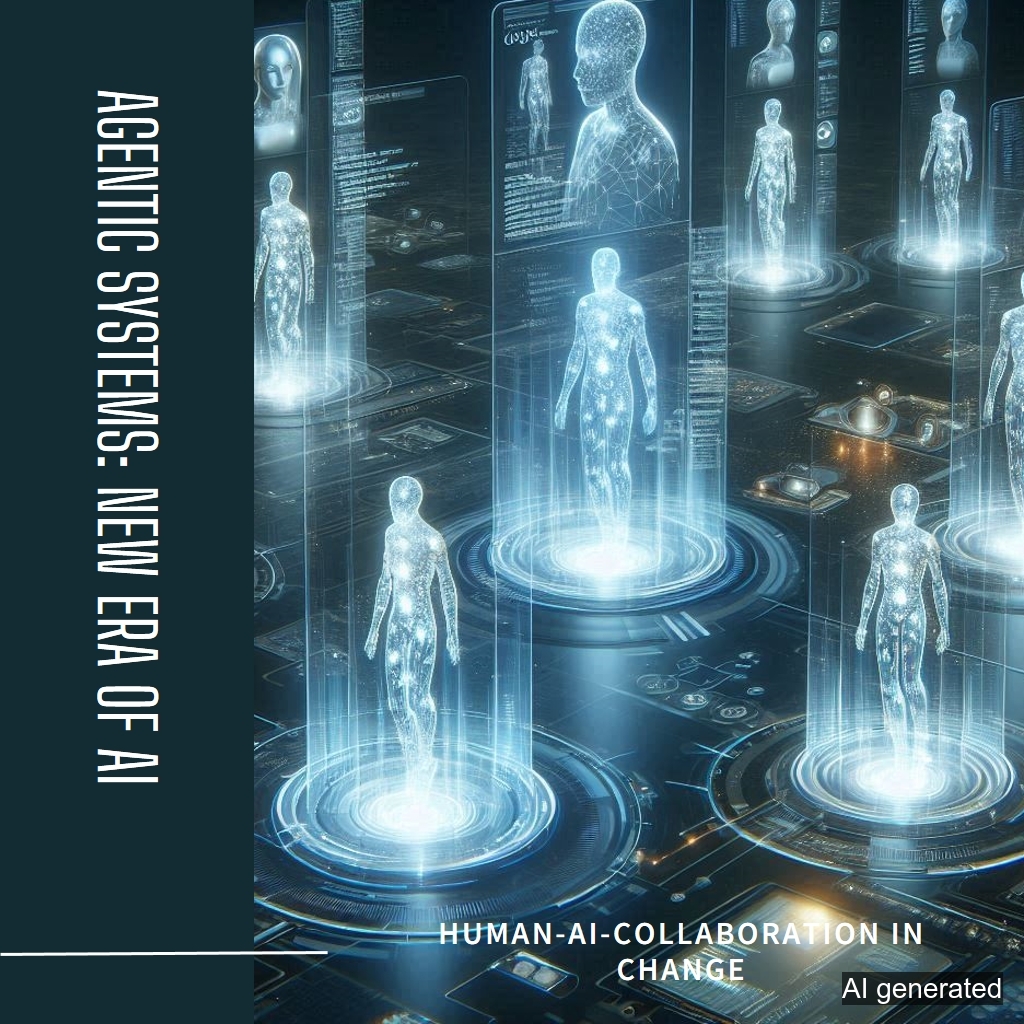
The Evolution of Autonomous Agents
Business informatics stands at the threshold of a fundamental transformation: while generative language models (LLMs) were primarily perceived as dialogue-based assistants over the past year, the current discourse is shifting toward agentic systems. These systems are characterized by their ability not only to generate text, but also to independently execute complex business processes through tool use, planning, and autonomous decision-making. For doctoral students, this shift opens up a highly relevant field of research that goes beyond mere implementation and raises fundamental questions about the structure of work and organizations.
Theoretical Classification and Concepts
The concept of agency—that is, a system’s ability to autonomously operate within defined goals—forms the theoretical core of this transformation. In contrast to last year, when research focused heavily on user acceptance of chatbots (based on TAM or UTAUT), attention is now returning to socio-technical systems theory. The key question is how to recalibrate the coupling of human expertise and algorithmic autonomy. Central theoretical reference points include concepts such as human-in-the-loop architectures and principal-agent theory in a digitized environment where the agent is no longer exclusively human but can also be a software entity.
Methodological Approaches and Research Designs
Studying agentic systems requires methodological innovation. While quantitative experiments can help quantify efficiency gains in standardized processes, understanding collaborative dynamics increasingly calls for qualitative longitudinal studies or design-oriented approaches (Design Science Research). Particularly promising for doctoral researchers are:
- Design Science Research: Development and evaluation of artifacts that act as intermediaries between AI agents and human decision-makers.
- Ethnographic studies: Examination of the gradual transformation of work processes in organizations that have already implemented initial agentic workflows.
- Comparative case studies: Analysis of different governance models in the introduction of autonomously acting AI systems in highly regulated industries.
Challenges and Tensions
Current research within the AIS Senior Scholars' Basket of Eight indicates that technological feasibility is currently outpacing theoretical discourse. Key areas of tension that offer opportunities for doctoral research include:
- Accountability: Who bears responsibility for erroneous decisions made by an autonomous agent operating within a chain of partial decisions?
- Transparency and explainability: How can the decision paths of complex agent workflows be made understandable to human actors without compromising performance?
- Skill erosion vs. empowerment: Does outsourcing complex cognitive tasks to agents lead to a loss of human competencies or an enhancement of job roles?
Implications for Practice and Future Research
For research practice, the rise of agentic systems implies a shift away from a purely output-oriented focus (text generation) toward process orientation. Practitioners face the challenge of not merely implementing individual tools but designing agentic ecosystems. This creates compelling entry points for doctoral research: for example, investigating the governance of AI agents in multinational corporations or modeling the changing work roles in departments such as controlling or procurement through the use of autonomous systems. The current debate invites a redefinition of the boundaries of human decision-making in the context of an algorithmically shaped world of work.
