

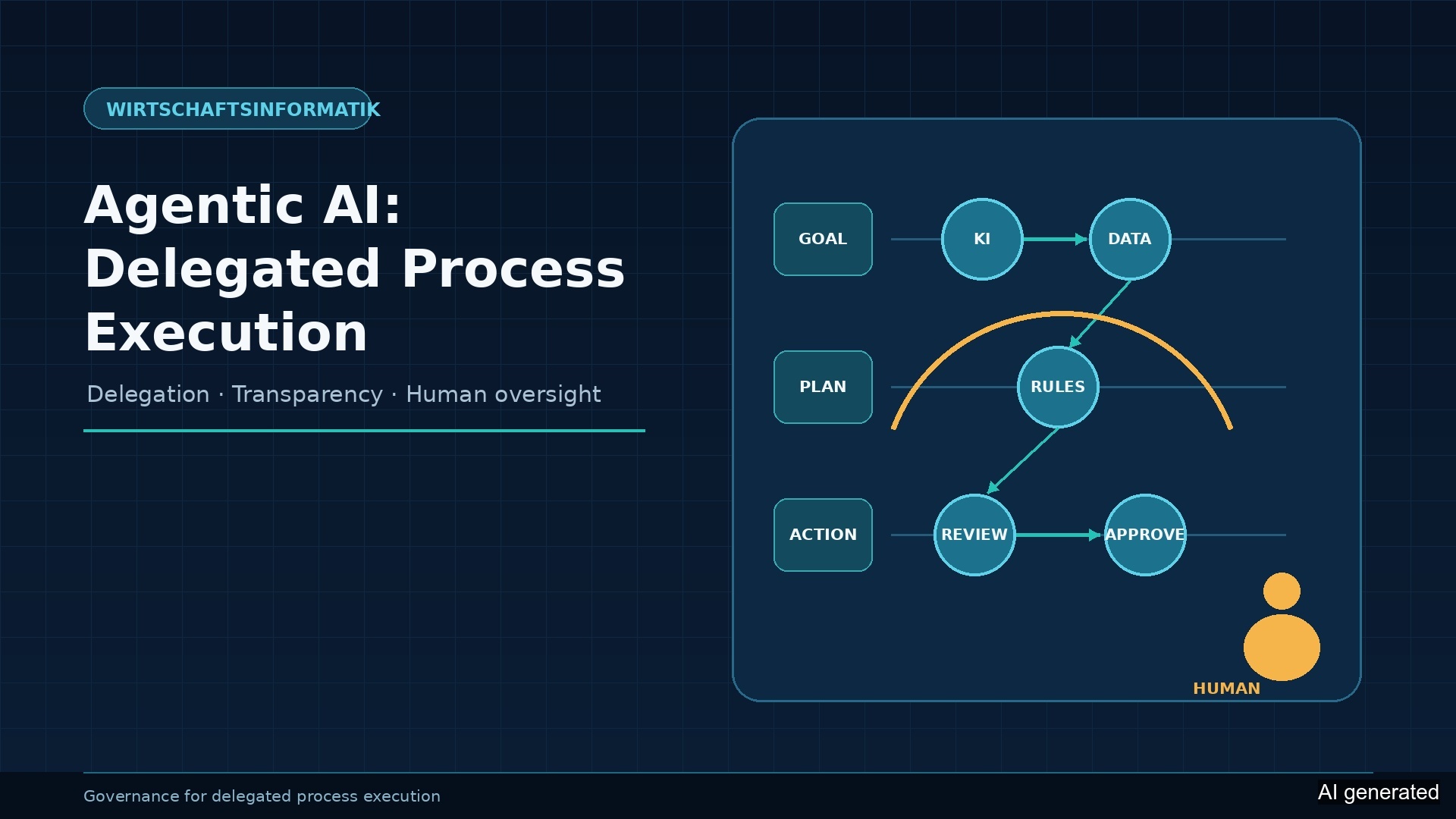
Generative artificial intelligence (AI) has rapidly become a widely used support technology. Initial attention focused primarily on applications that generate text, images, software code, or summaries. Increasingly, however, attention is shifting to systems that do more than produce individual pieces of content: they interpret goals, plan work steps, access data sources and digital tools, evaluate intermediate results, and initiate actions within defined limits. This development is commonly referred to as agentic AI.
For the information systems discipline, this development entails a shift in research priorities. The quality of individual AI outputs is no longer the sole focus. Instead, the central questions concern how tasks are allocated between people and AI systems, how decision-making and action authority can be constrained technically and organizationally, and how transparency, oversight, and accountability can be ensured in AI-enabled processes. Agentic information systems are therefore increasingly viewed as a distinct subject of research on delegation, coordination, governance, and human-AI collaboration (Holldack et al., 2026; Kumar et al., 2026).
What Is Agentic AI?
Agentic AI is neither a single technology nor a synonym for a large language model. Rather, the term refers to a class of AI-based systems that can independently plan and execute subtasks within predefined objectives, rules, and permissions. Typical capabilities include decomposing an objective into subtasks, selecting appropriate tools, accessing authorized information sources, evaluating intermediate results, and adapting a course of action when deviations or new information arise.
A conventional assistant system typically responds to a single prompt and produces, for example, a summary, a draft, or an analysis. An agentic system, by contrast, can manage a coherent process. For instance, it may review an application for completeness, consolidate information from multiple specialized systems, identify missing documents, prepare a draft request for additional information, submit a case for approval, and, after human confirmation, initiate further permissible process steps.
The central distinction, therefore, lies in delegated process execution. Users do not necessarily specify every individual action. Instead, they define objectives, rules, data access rights, tool permissions, quality requirements, and escalation mechanisms. The system is thereby granted limited technical discretion to act. However, this technical capacity for action must not be confused with human or organizational responsibility. An AI system may prepare or execute actions, but it cannot assume legal or moral responsibility.
Holldack, Banh, and Strobel distinguish agentic information systems from traditionally reactive information systems by their ability to make decisions, act in unstructured environments, and enable new forms of task delegation between people and systems (Holldack et al., 2026). This challenges the primary role of humans as the sole acting entities, which information systems research has often assumed, without transferring responsibility or legitimacy to technical systems.
From Tool to Process Actor
The introduction of agentic AI changes the design of digital work. While conventional information systems process data, provide information, or execute clearly defined transactions, agentic systems can assume parts of planning and coordination work. They do not become equal human actors; nevertheless, they become technically capable components of a sociotechnical work system.
This development can be understood as a transition from point-based assistance to structured delegation. The relevant question is no longer simply, “Can the system generate a good answer?” Equally important questions include: “Which tasks may be delegated?”, “Which actions require prior human approval?”, “How are decisions and tool calls documented?”, and “Who is responsible for the consequences when a system acts incorrectly or unexpectedly?”
Current discussion in behavioral information systems research suggests that AI is reshaping the research landscape along several dimensions. In addition to an agentic shift, in which systems prepare or execute actions, there is an epistemic shift driven by probabilistic and partly opaque system behavior, as well as a cognitive shift resulting from repeated use of AI-supported thinking and decision support (Grover & Tarafdar, 2026). For organizations, this means that the introduction of agentic AI should not be treated as an isolated IT project, but rather as a transformation of decision rights, capabilities, routines, and control structures.
Theoretical Perspectives
Information systems research provides several theoretical perspectives for examining agentic AI. Particularly relevant are the sociotechnical systems perspective, the task-technology fit approach, research on trust in automation, and perspectives on IT governance and accountability.
The sociotechnical systems perspective emphasizes that work performance does not result from technology alone. It depends on the interaction of people, tasks, data, technologies, rules, skills, and organizational routines. Agentic AI changes this configuration because it does not merely provide information; within defined limits, it plans, prioritizes, prepares, or executes tasks. The technical performance of a system is therefore only one condition of its value. Organizational embedding, the quality of underlying data, appropriate role models, and clearly defined escalation paths are equally important.
The task-technology fit approach demonstrates that information technology is particularly effective when its functionalities fit the characteristics of a task and the needs of its users (Goodhue & Thompson, 1995). In the context of agentic AI, this fit extends beyond a system’s technical ability to perform a task. It also concerns the appropriate degree of delegation. Routine, reversible, and readily verifiable activities may be largely automated. Decisions with significant consequences, limited reversibility, or strong contextual dependence, by contrast, require more stringent controls and approval mechanisms.
Research on trust in automation complements this perspective. Trust is not inherently positive; it must correspond to a system’s actual capabilities and limitations. Excessive trust can lead to the uncritical acceptance of system recommendations, while insufficient trust can prevent useful support from being used effectively. Lee and See refer to this as appropriate trust and appropriate reliance (Lee & See, 2004). This challenge is particularly pronounced in agentic AI because errors may not be limited to a single output but can propagate across multistep plans, data access operations, and tool calls.
Research and Design of Agentic Systems
Agentic AI opens up a broad field of research for information systems scholars. A design-oriented research approach is particularly suitable. Design science research aims to address relevant problems through innovative artifacts and to systematically evaluate their utility (Hevner et al., 2004). In the context of agentic AI, such artifacts may be technical, organizational, or hybrid design objects.
Examples include reference architectures for secure tool use, role and authorization concepts for AI agents, audit trails that document planning steps, patterns for risk-appropriate approvals, or procedures for classifying tasks according to their suitability for delegation. A design science research project could, for example, examine how an AI agent can conduct an initial review of applications in a public-sector administrative process, identify missing information, and prepare standardized requests for clarification without independently making legally binding decisions.
In addition to design science research, experimental designs and case studies are relevant. Experiments can be used to investigate, for example, the effects of different transparency or approval mechanisms on task quality, processing time, error detection, and trust. Case studies make it possible to examine the introduction of agentic systems in real organizational contexts. The focus then lies on changes in roles, routines, decision rights, competency requirements, and coordination processes.
A rigorous evaluation of agentic AI should not end with the quality of a final output. It should also examine whether the system documents its actions in a comprehensible manner, whether escalations occur at the appropriate time, whether human interventions are effective, how robustly the system responds to incomplete or contradictory information, and whether technical delegation leads to an actual improvement in the work system.
Governance and Human Oversight
The greater the technical discretion available to an AI system, the more important governance mechanisms become. In this context, governance encompasses more than legal requirements. It also includes organizational rules, technical safeguards, role and authorization concepts, documentation requirements, approval processes, escalation paths, and mechanisms for control and intervention.
A central design task is to ensure that human oversight is effective rather than merely formal. Under a human-in-the-loop arrangement, a person reviews or approves an action before it is executed. Under a human-on-the-loop arrangement, a responsible person monitors system operation and intervenes in the event of exceptions, warnings, or malfunction. Under a human-in-command arrangement, overarching decision-making authority and responsibility remain with human roles and the responsible organization.
The European AI Act requires effective human oversight for high-risk AI systems. Such oversight must, among other things, enable people to understand a system’s capabilities and limitations, identify potential anomalies, avoid automation bias, override system outputs, and safely interrupt system operation when necessary (European Union, 2024). These requirements are also valuable design principles in contexts where the AI Act does not establish a specific oversight obligation.
For systematic risk management, the National Institute of Standards and Technology’s AI Risk Management Framework provides a life cycle-oriented framework. The accompanying profile for generative AI addresses risks specific to generative systems and supports organizations in considering risks during design, development, deployment, and continuous monitoring (National Institute of Standards and Technology, 2024). In the case of agentic systems, organizations must also assess risks arising from the combination of models, data sources, tools, permissions, and process logic.
Recent Research Signals from the AIS Senior Scholars’ Basket of Eight
The most recent publicly visible contributions from journals in the AIS Senior Scholars’ Basket of Eight indicate a clear shift: AI-supported decision work, responsible platform and data governance, and human-centered digitalization are gaining importance. At the same time, digital health, cyber and information security, and the methodological foundations of digital innovation remain important research areas.
This assessment is deliberately selective. The publishers’ websites for the eight journals vary in the currency, completeness, and accessibility of their issue, article, and online-first indexes. The following selection therefore focuses on more recent contributions whose titles, journal affiliations, publication status, and core bibliographic details could be clearly verified.
Human-AI Collaboration and Responsible Decision Support
Several recent research contributions move away from a pure replacement logic in which algorithms are expected to replace human decisions. Instead, they examine how information about system performance, decision processes, and the limitations of algorithmic recommendations can improve collaboration between people and AI.
A recent study in Information Systems Research examines whether information about the performance of an algorithmic decision system can improve human decisions in inventory ordering. Based on field experiments, the study finds that both positive and negative performance information can improve managers’ ordering decisions. The effect was particularly pronounced for negative performance information (Liu et al., 2025).
This finding is especially relevant for agentic AI and public-sector digitalization. Transparency should not be reduced to disclosing a recommendation or providing an explanation after the fact. Employees need understandable information about empirically observed system performance, error boundaries, uncertainties, and known limitations. Such information can support appropriate reliance on algorithmic recommendations and help prevent both automation bias and blanket rejection of AI-supported decisions.
A recent article in MIS Quarterly also highlights the importance of data-driven systems for organizational governance and compliance. The article Can Business Intelligence Help Companies Avoid Compliance Troubles? examines the extent to which business intelligence capabilities can help organizations address compliance challenges more effectively, strengthen risk management practices, and meet regulatory requirements (Zhang et al., 2026). This is particularly relevant for public administration and regulated organizations because it connects business intelligence with early warning, evidence generation, control, and accountability.
Digital Platforms, Ecosystems, and Power Structures
Current research continues to examine digital platforms both as innovation infrastructures and as governance and power structures. Platforms enable new forms of use, complementary services, and value creation through modular and connected digital architectures. At the same time, platform operators influence access to data, interoperability, rule-setting, and the distribution of value within digital ecosystems.
For public-sector organizations, these perspectives are particularly important when evaluating cloud platforms, shared foundational services, modular line-of-business systems, and AI infrastructure. Platform strategies should therefore not be assessed solely in terms of functionality, implementation speed, or efficiency. They also require an assessment of interoperability, data portability, dependency risks, governance rights, procurement options, and long-term control over critical digital capabilities.
Generative and agentic AI intensify these issues. Access to foundation models, training data, cloud infrastructure, and application programming interfaces is increasingly concentrated among a limited number of providers. Platform governance must therefore extend beyond technical architecture and take into account economic dependencies, data sovereignty, auditability, and the distribution of decision rights.
Trust, Acceptance, and Digital Behavior
A further stream of research demonstrates that the effects of digital systems do not depend solely on technical functionality. Trust, perceived fairness, attention, emotional processing, and the interpretation of information signals influence whether digital services are accepted and used appropriately. This insight applies equally to digital payment systems, platforms, online communication, and AI-enabled public services.
For digital public services, this means that communication, explainability, and perceived procedural fairness are not secondary usability concerns. They are prerequisites for acceptance, appropriate use, and institutional legitimacy. A technically correct recommendation may fail to create value if affected individuals, caseworkers, or decision makers cannot understand how it was generated, perceive it as unfair, or lack a meaningful opportunity to question, review, or correct it.
Agentic AI increases the importance of these requirements. When systems do not merely generate recommendations but also plan, prioritize, or technically execute process steps, people must be able to recognize which objectives the system is pursuing, which information sources it uses, which assumptions underlie its planning, and at what point a human decision is required.
Resilient Work and Security Practices
Research also highlights the burden side of digitalization. Digital work practices, security requirements, and process standards do not automatically improve performance or well-being. Their effects depend on whether they fit the work context, support actual tasks, and reduce avoidable cognitive and administrative burdens.
Research on security fatigue is particularly relevant in this context. Malik, Goel, and Sinha conceptualize security fatigue as an expression of emotional exhaustion and cynicism resulting from depleted self-regulatory capacity (Malik et al., 2026). This suggests that additional security requirements, alerts, and compliance obligations do not automatically lead to better security. Instead, security should be designed into workflows, provide context-sensitive guidance, use sensible default settings, automate routine controls, and reduce unnecessary interruptions.
This consideration is directly relevant to agentic AI. If AI agents generate additional review tasks, approval requests, exception notifications, or monitoring obligations, the resulting oversight work must remain practically manageable. Human oversight is effective only when responsible individuals have sufficient time, understandable information, appropriate intervention rights, and genuinely usable options for intervention.
Methodological Foundations of Digital Innovation
Methodological contributions remain essential because organizations increasingly expect AI and digitalization initiatives to demonstrate traceable value beyond technical feasibility. The development of AI assistants, process tools, digital platforms, and agentic systems therefore requires evaluation designs that are scientifically rigorous while also being feasible in applied settings.
Baskerville, Pries-Heje, and Venable introduce MEDS, a methodology for evaluation in design science research. MEDS comprises four steps: defining evaluation objectives, selecting an evaluation strategy, selecting the properties to be evaluated, and planning individual evaluation episodes (Baskerville et al., 2026). The methodology is especially relevant for AI-enabled artifacts because it helps prioritize evaluation criteria and align evaluation effort with an artifact’s maturity, risk profile, and intended use context.
For agentic AI, evaluation should therefore consider far more than output quality or technical accuracy. Relevant evaluation dimensions include reliable task completion, robustness, traceability, the quality of escalations, the effectiveness of human interventions, fairness, information security, resource consumption, and effects on organizational routines and human expertise.
Key Research Questions
The development and implementation of agentic AI raise several central questions for research and practice:
- Delegation: What criteria can organizations use to decide whether a task may be prepared by an AI agent, executed under human oversight, or should not be delegated at all?
- Transparency: What information about objectives, plans, data access, tool calls, performance limitations, and uncertainty do people need to assess system behavior appropriately?
- Trust: How can interaction and explanation mechanisms be designed to avoid both uncritical reliance and blanket rejection of AI-supported process execution?
- Competence: What long-term effects does the delegation of cognitive planning and coordination tasks have on professional judgment, learning processes, and the expertise of knowledge workers?
- Accountability: How can actions along a chain of human instructions, agentic planning, data access, tool use, and approvals be documented in a traceable manner and attributed to responsible roles?
- Platform governance: How can public-sector organizations ensure interoperability, data sovereignty, portability, and strategic control when central AI capabilities are obtained through external platforms and infrastructure?
- Resilience: How must agentic systems be designed so that they respond in a controlled manner to inaccurate data, conflicting instructions, unexpected tool responses, or malicious inputs?
- Evaluation: What technical, organizational, ethical, and legal criteria are required to evaluate the benefits and risks of agentic systems throughout pilot implementation and operational use?
Implications for Public-Sector Digitalization
Taken together, current research signals suggest five practical implications for public-sector digitalization and the design of agentic information systems:
- Design AI as accountable decision support: AI-supported recommendations should be transparent, reviewable, and embedded in clearly defined decision rights. Information about system performance, uncertainty, and known limitations supports appropriate use.
- Connect analytics with governance: Business intelligence, process mining, and AI analytics should support early warning, evidence generation, compliance monitoring, and organizational learning rather than merely providing dashboards or isolated predictions.
- Assess platforms strategically: Platform decisions require an analysis of interoperability, data portability, data access, contractual governance, dependency risks, and long-term control over critical digital capabilities.
- Reduce rather than shift work burdens: Digital processes, security controls, and AI oversight mechanisms should reduce unnecessary interruptions and administrative burdens rather than shifting hidden coordination and control work onto employees.
- Evaluate artifacts systematically: AI and digitalization projects should define measurable evaluation criteria at an early stage and assess technical, organizational, ethical, and legal effects throughout development, pilot implementation, and operation.
Conclusion
Agentic AI extends generative AI by enabling limited, technically mediated process execution. This does not create an autonomously responsible actor; rather, it creates an information system with expanded capabilities for planning, coordination, and action. For information systems research, the focus therefore shifts from the isolated evaluation of AI outputs to the design of hybrid work systems in which humans and AI assume different, clearly defined responsibilities.
Recent research signals from journals in the AIS Senior Scholars’ Basket of Eight support this interpretation. They point to the importance of human-centered decision support, responsible data and platform governance, resilient work and security practices, and methodologically rigorous evaluation. AI is thus not viewed as a self-contained automation technology, but as a component of sociotechnical systems whose value depends on task fit, transparency, oversight, competence, and institutional embedding.
The value of agentic AI therefore does not depend solely on model performance or the degree of automation. It depends on task-appropriate delegation, transparent system boundaries, effective human oversight, robust governance structures, and traceable attribution of responsibility. This is precisely where a central research and design field for information systems emerges: developing and deploying agentic systems in ways that meaningfully extend human work without undermining control, expertise, or accountability.
References
- Baskerville, R., Pries-Heje, J., & Venable, J. R. (2026). MEDS: Methodology for evaluation in design science. European Journal of Information Systems. Advance online publication. https://doi.org/10.1080/0960085X.2026.2627280
- European Union. (2024). Regulation (EU) 2024/1689 of the European Parliament and of the Council of 13 June 2024 laying down harmonized rules on artificial intelligence and amending Regulations (EC) No 300/2008, (EU) No 167/2013, (EU) No 168/2013, (EU) 2018/858, (EU) 2018/1139 and (EU) 2019/2144 and Directives 2014/90/EU, (EU) 2016/797 and (EU) 2020/1828 (Artificial Intelligence Act). Official Journal of the European Union, L 1689. https://eur-lex.europa.eu/eli/reg/2024/1689/oj
- Goodhue, D. L., & Thompson, R. L. (1995). Task-technology fit and individual performance. MIS Quarterly, 19(2), 213–236. https://doi.org/10.2307/249689
- Grover, V., & Tarafdar, M. (2026). The changing landscape of behavioral IS research: Navigating agentic, epistemic, and cognitive shifts. Journal of the Association for Information Systems, 27(3), 568–580. https://doi.org/10.17705/1jais.00994
- Hevner, A. R., March, S. T., Park, J., & Ram, S. (2004). Design science in information systems research. MIS Quarterly, 28(1), 75–105. https://doi.org/10.2307/25148625
- Holldack, F., Banh, L., & Strobel, G. (2026). Agentic information systems. Electronic Markets, 36, Article 5. https://doi.org/10.1007/s12525-025-00861-0
- Kumar, N., Wang, X., & Hanneke, R. (2026). Agentic artificial intelligence as a new frontier in information systems: Promise, peril, and research opportunities. Information & Management, 63, Article 104317. https://doi.org/10.1016/j.im.2026.104317
- Lee, J. D., & See, K. A. (2004). Trust in automation: Designing for appropriate reliance. Human Factors, 46(1), 50–80. https://doi.org/10.1518/hfes.46.1.50_30392
- Liu, Y., et al. (2025). Can providing algorithmic performance information facilitate humans’ inventory ordering behaviors? Information Systems Research, 37(1), 1–19. https://doi.org/10.1287/isre.2022.0621
- Malik, A., Goel, S., & Sinha, S. (2026). Security fatigue: Manifestation of emotional exhaustion and cynicism by depletion of self-regulation capacity. European Journal of Information Systems, 35(5), 785–804. https://doi.org/10.1080/0960085X.2026.2621809
- National Institute of Standards and Technology. (2024). Artificial intelligence risk management framework: Generative artificial intelligence profile (NIST AI 600-1). U.S. Department of Commerce. https://doi.org/10.6028/NIST.AI.600-1
- Peffers, K., Tuunanen, T., Rothenberger, M. A., & Chatterjee, S. (2007). A design science research methodology for information systems research. Journal of Management Information Systems, 24(3), 45–77. https://doi.org/10.2753/MIS0742-1222240302
- Trist, E. L., & Bamforth, K. W. (1951). Some social and psychological consequences of the longwall method of coal-getting: An examination of the psychological situation and defenses of a work group in relation to the social structure and technological content of the work system. Human Relations, 4(1), 3–38. https://doi.org/10.1177/001872675100400101
- Zhang, Y., et al. (2026). Can business intelligence help companies avoid compliance troubles? MIS Quarterly. https://doi.org/10.25300/MISQ/2026/19073/3861
