

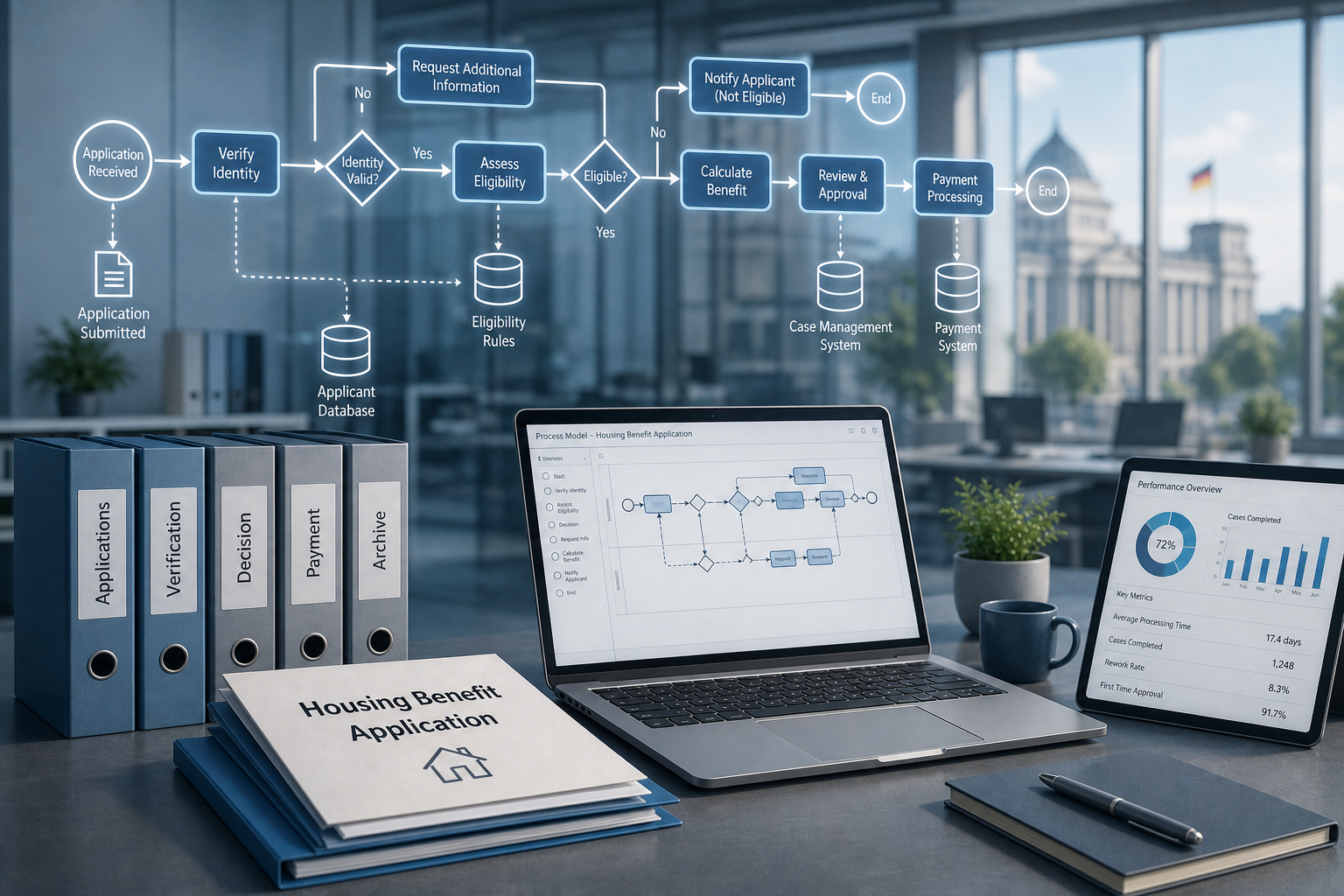
Process intelligence describes a government’s ability to make its processes transparent, analyze them based on data, and then steer and automate them accordingly. BPMN 2.0 is the key process language for this in the German public sector and is used in an adapted form within the FIM methodology (Föderales Informationsmanagement/Federal Information Management) (FITKO, 2013, Federal Office of Administration, 2024).
Starting Point: Process Documentation Without Process Intelligence
Many public organizations document their processes in manuals, administrative orders, or textual process descriptions that are often fragmented, hard to find, out of date, and not machine-readable (Federal Ministry of the Interior and Community, 2025). As a result, processes can neither be automatically analyzed nor linked to meaningful metrics, nor can they be used directly as a basis for IT implementations (FITKO, 2019).
Media breaks, long throughput times, and inconsistent processing paths remain invisible without standardized process modeling. Model-based descriptions using BPMN 2.0 and FIM-BPMN change that by translating business processes into a formally defined language that is understood across organizations (FITKO, 2013, Heitkötter et al., 2010).
What Exactly Is BPMN 2.0?
BPMN (Business Process Model and Notation) is a standard for graphical business process modeling developed by the Object Management Group (OMG), and has been internationally standardized as ISO/IEC 19510:2013 since 2013 (FITKO, 2013). A BPMN model describes processes using a defined set of symbols and elements, including:
- Activities (tasks) for business work steps
- Events for process start, intermediate events, and process end
- Gateways for data- or event-based decisions and branching
- Sequence flows for the logical order of process steps
- Lanes and pools for roles and organizational units
Unlike simple flowcharts, a BPMN model is formally defined, standardized, and machine-readable. In suitable tools, it can be validated, analyzed, and executed in a process engine, which allows business models to serve directly as a foundation for technical implementations (Federal Office of Administration, 2024).
Why BPMN Is the De Facto Standard in the German Public Sector
The Federal Office of Administration (Bundesverwaltungsamt, BVA) has established BPMN 2.0 as a binding standard in the federal government’s process management toolset and has operationalized it using best-practice guidelines, a conventions handbook, and an attribute catalog (Federal Office of Administration, 2024). At the same time, the FIM methodology defines a public sector-specific specialization of BPMN 2.0 (FIM-BPMN) that restricts the notation to a curated symbol set and introduces modeling conventions (FITKO, 2013, FITKO, 2019).
A Shared Language Between Business and IT
BPMN enables subject-matter experts to describe their processes precisely without needing programming skills, while IT departments can use the same models to derive workflows, interfaces, and configurations for line-of-business applications (Federal Office of Administration, 2024). This creates a shared process language that reduces misunderstandings and increases the traceability of implementation decisions (Federal Ministry of the Interior and Community, 2025).
Cross-Agency Standardization with FIM-BPMN
Within the FIM methodology, core processes are modeled using FIM-BPMN. Here, the use of BPMN 2.0 is restricted to a defined set of allowed elements to ensure a consistent level of detail and high reusability of process models (FITKO, 2013, FITKO, 2019). This enables federal, state, and local governments to exchange process models and systematically support reuse (PICTURE GmbH, 2021).
Foundation for Automation and OZG Implementation
Implementation of the German Online Access Act (Onlinezugangsgesetz, OZG), workflow platforms, RPA scenarios, and AI-supported case handling all depend on clearly defined, reusable process models. BPMN and FIM-BPMN models provide this foundation by describing automation paths, interfaces, and data flows in a way that is explicit and auditable (FITKO, 2019, Federal Office of Administration, 2024).
Core BPMN 2.0 Elements in Everyday Public Sector Use
The following basic elements appear in virtually every public sector process and are clearly defined in the FIM-BPMN building blocks (FITKO, 2013):
| Element | Meaning in public sector processes |
|---|---|
| Start event (circle) | Triggers a case, e.g., receipt of an application. |
| End event (bold circle) | Closes the case, e.g., dispatch of a notice. |
| Task (rectangle) | Concrete processing step performed by a role. |
| Exclusive gateway (diamond with X) | Either-or decision, such as completeness “yes/no”. |
| Parallel gateway (diamond with +) | Parallel execution of multiple subprocesses. |
| Lane | Responsibility area, e.g., case worker, team lead. |
| Pool | Organizational unit, e.g., department or agency. |
In FIM-BPMN, these elements are further refined by modeling conventions, for example regarding task naming, pool structure, and representation of data objects and data stores (FITKO, 2013, Federal Office of Administration, 2024).
Practice Example: Housing Benefit Application as a BPMN Model
A typical housing benefit (Wohngeld) application can be modeled using BPMN and FIM-BPMN as follows (Federal Ministry of the Interior and Community, 2025):
- Start event: Application received via online portal or paper mail.
- Task: Formal completeness check performed by the case worker.
- Exclusive gateway: Is the application complete? If “no”, request missing documents; if “yes”, proceed to the substantive review.
- Task: Substantive review of eligibility criteria.
- Task: Calculation of the housing benefit amount.
- Task: Drafting and dispatch of the decision notice.
- End event: Case closed; relevant data are transferred to core systems and statistics.
Such a model does more than visualize the process. It provides a basis for measuring throughput times, identifying bottlenecks, and systematically designing automation steps—for example, automated completeness checks or automated decision drafting (FITKO, 2019, PICTURE GmbH, 2021).
Levels of Maturity in BPMN Use in Government
From a process intelligence perspective, BPMN usage can be grouped into three maturity levels, each with distinct requirements for methodology, governance, and technology (Federal Office of Administration, 2024, FITKO, 2019):
Maturity Level 1 – Documentation
Processes are modeled using BPMN or FIM-BPMN to achieve transparency and knowledge retention. Models are broadly conformant with FIM and BVA conventions but are used mostly in a static way—for instance, for training or for documenting OZG service processes (Federal Ministry of the Interior and Community, 2025).
Maturity Level 2 – Optimization
BPMN models are actively analyzed, linked to metrics, and transformed into target-state process models. The conventions handbook, best-practice guides, and FIM quality criteria function as a reference framework for systematic process improvement (Federal Office of Administration, 2024, FITKO, 2019). Process intelligence at this level emerges from connecting models, measurement, and management decisions.
Maturity Level 3 – Automation
At maturity level 3, BPMN models form the foundation for executable workflows in process engines, automated interfaces, and combined use of RPA and AI. Changes in process design are propagated in a controlled, versioned, and auditable way into technical execution (Federal Office of Administration, 2024, PICTURE GmbH, 2021). Many agencies currently operate between level 0 (no standardized modeling) and level 1, which means optimization and automation potentials are far from being fully leveraged (Federal Ministry of the Interior and Community, 2025).
Typical Pitfalls in Introducing BPMN
Experience reports from federal and state administrations show recurring challenges when introducing BPMN and FIM-BPMN (Federal Office of Administration, 2024):
- Excessive detail too early: Instead of starting with end-to-end views, organizations immediately model subprocesses at a very granular level and lose sight of the overall process.
- Treating BPMN as a pure IT project: Modeling is moved into technical projects instead of being led by the business and owned by process owners.
- Missing governance: There are no clearly defined roles for process ownership, quality assurance, convention management, and training.
- Models without a usage concept: BPMN models are created but not systematically used for OZG implementation, KPI systems, training, or automation.
A successful BPMN rollout combines methodology (FIM-BPMN, conventions handbook), governance (roles, responsibilities), and technology (tools, process engines) into a coherent overall system (Federal Office of Administration, 2024, FITKO, 2019).
Conclusion: BPMN as an Infrastructure Building Block for Process Intelligence
BPMN 2.0—operationalized in the public sector through FIM-BPMN and BVA conventions—is more than just a modeling standard. It is an infrastructure building block for process intelligence: processes become transparent, comparable, and measurable; improvements can be planned based on facts; and automation becomes manageable and aligned with OZG and broader digital transformation programs (FITKO, 2019, Federal Office of Administration, 2024).
Anyone talking seriously about digital government is, sooner or later, talking about BPMN— as a shared language between business and IT and as a foundation for scalable, intelligent process landscapes (FITKO, 2013, Federal Ministry of the Interior and Community, 2025).
Related Articles
- Process-Oriented Thinking vs. Department-Oriented Thinking: Why the Administration Needs to Fundamentally Change Its Mindset
- Federal Information Management (FIM): The Underrated Standard of Public Sector Digitalization
- Process Automation in Administration: A Comparison of RPA, Low-Code, and Workflow Engines
References
- Federal Office of Administration. (2024). Best practices in BPMN modeling – basics (Version 1.0). Competence Center for Process Management – Standards and recommendations for a uniform federal process management. https://www.bva.bund.de/SharedDocs/Downloads/DE/Behoerden/Beratung/Prozessmanagement/PMT/Best_Practices_PMT.pdf
- FITKO. (2013). FIM-BPMN: Modeling core processes with BPMN 2.0. Federal development portal.
https://docs.fitko.de/fim/docs/prozesse/fachkonzept/prozessbaukasten/fim-bpmn - FITKO. (2019). FIM portal: Federal Information Management – Processes. https://docs.fitko.de/resources/fim/
- Federal Ministry of the Interior and Community. (2025). Organizational handbook of the federal government: Capturing and documenting process flows. https://www.orghandbuch.de/
- PICTURE GmbH. (2021). Modeling and reusing FIM processes with the PICTURE process platform. PICTURE GmbH. https://www.picture-gmbh.de/
- Heitkötter, H., Zeller, V., & Becker, J. (2010). Transforming PICTURE to BPMN 2.0 as part of model-driven development in public administration. In Proceedings of the Workshop on Method Engineering.